
Time Management for Professionals That Actually Works in 2026

Table of Contents
Introduction
Your inbox hits 247 unread by 10 AM. Back-to-back meetings consume your afternoon with zero progress on actual deliverables.
Ring a bell?
Most professionals waste hours daily without realizing it. Generic productivity advice fails because it ignores real workplace constraints. You'll discover proven frameworks backed by data that actually work in demanding professional environments.
Why 73% of Professionals Waste Time Without Realizing It
The Real Numbers Behind Wasted Professional Time
Employees spend only 27% of their time on skills-based work. That's according to Asana's workplace research. The other 73% vanishes into meetings, emails, and administrative tasks.
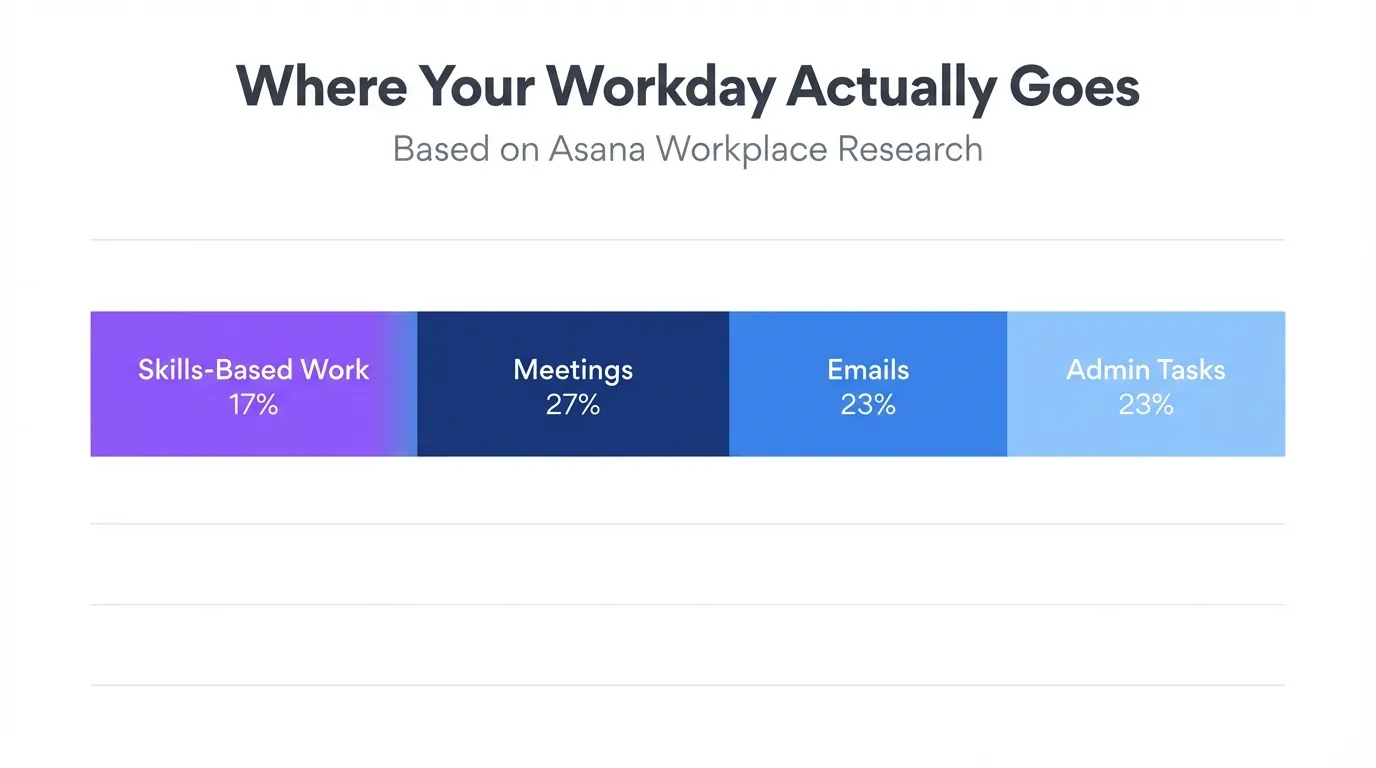
Consider that ratio for a moment.
Companies hire you for expertise and judgment. But three-quarters of your day disappears into everything except that core value. Slack's research reveals nearly half of workers waste time searching for information they need to do their jobs. This isn't laziness. It's structural inefficiency baked into modern work culture.
A third of surveyed workers struggle with motivation. Nearly as many can't stay focused.
How Poor Time Management Kills Career Growth
Poor time management creates a vicious cycle. You're always behind, so you look disorganized. Looking disorganized means you're passed over for promotions. Missing deadlines erodes trust with managers and clients. Workplace stress climbs while job satisfaction tanks.
Your perceived competence directly correlates with how well you manage your workload. The professionals who advance aren't necessarily the smartest. They're the ones who appear in control of their time.
The Eisenhower Matrix Stops You From Working on the Wrong Things
How the Four Quadrants Actually Work in Real Jobs
The Eisenhower Matrix splits tasks into four categories. Quadrant 1 holds urgent and important items - client crises and hard deadlines.
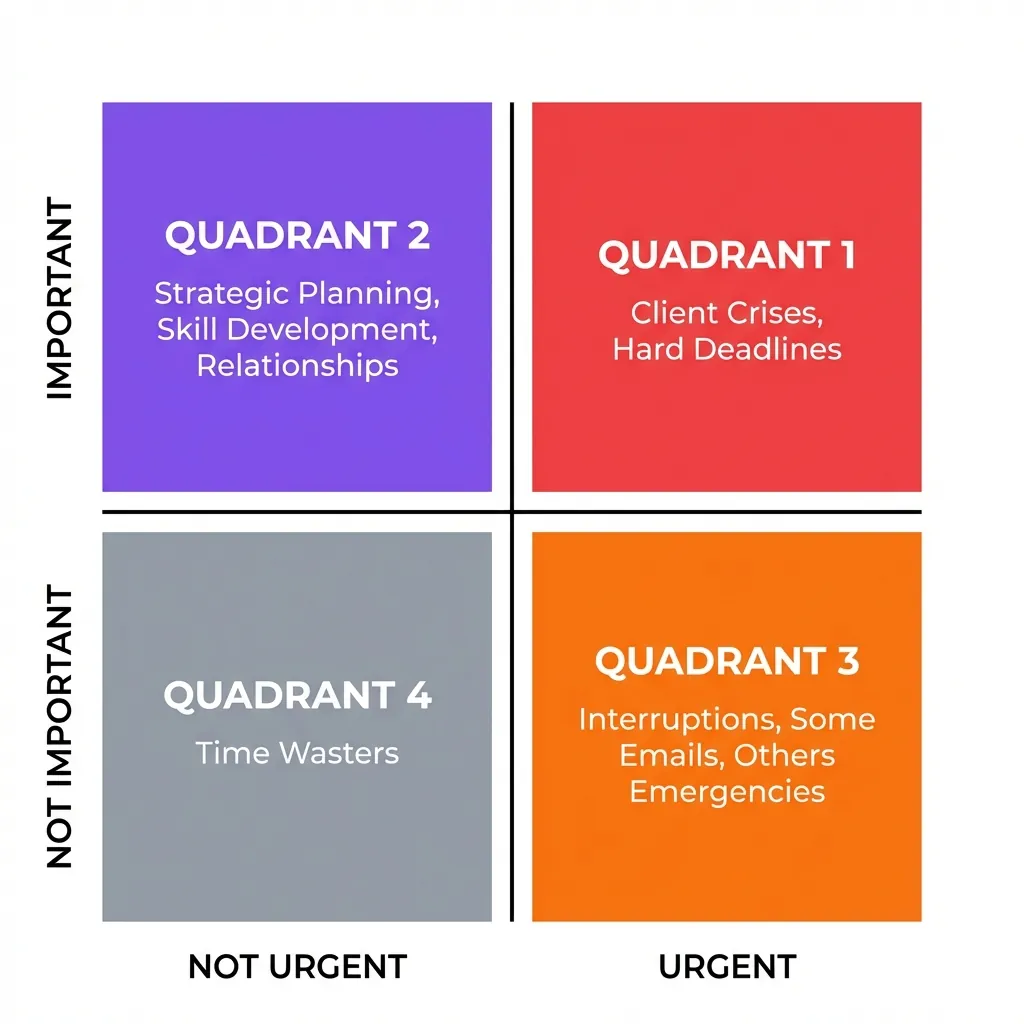
Quadrant 2 contains important but not urgent work. This includes strategic planning, skill development, and relationship building.
- Quadrant 3 traps many professionals: urgent but not important tasks. Think interruptions, some emails, and other people's emergencies.
- Quadrant 4 is neither urgent nor important - pure time-wasters.
Most people live in Quadrants 1 and 3. High performers focus on Quadrant 2.
Why Ruthless Prioritization Beats Trying to Do Everything
Katelyn Reilly, co-CEO of Steyer Content, puts it bluntly. "Everything can't be mission-critical - you need to choose and determine the highest-level use of your time." Running four ventures taught me this through painful experience. You physically cannot excel at everything simultaneously. Effective prioritization frameworks require acknowledging your limits and focusing relentlessly on highest-impact activities.
At some point, Reilly asked herself what tasks she could outsource or drop. She's a perfectionist but learned she can't keep a super-high bar in every single area. Neither can you. Proven time management techniques all start with accepting this reality.
Time Blocking Increases Productivity by 60 Percent
What the Data Shows About Time Blocking Success
Highly productive workers are 60% more likely to time-block tasks.
Zero-based calendar blocking goes a step beyond. You account for every minute of your day. This stops procrastination because there's no "empty" time to waste. It makes you budget time appropriately for each task type.
The Second Shift Method for Professional Development
Corinne Stroum manages at a California healthcare organization. She describes her approach: "We call it 'second shift' at my house."
She unplugs at the end of the workday. Maybe takes a walk, has dinner. Then she adopts the mindset of "it's school time." She gets more work done during this time because there are fewer distractions.
This applies to any professional development commitment (certifications, skills training, industry research).
For professionals who attend webinars and watch training videos as part of their development, AI VidSummary serves as a time-saving resource for extracting key insights from conference recordings and professional development content without watching full videos. Treat your learning time like a real job with dedicated blocks. The mental reset between work mode and learning mode makes both more effective.
Flow State Beats Multitasking Every Single Time
The Science Behind Peak Productivity States
Flow state means complete immersion in an activity. Psychologist Mihaly Csikszentmihalyi developed this concept. During Flow, you function at peak productivity and creativity levels.
Most professionals work the exact opposite way.
Why Multitasking Destroys Your Efficiency
The American Psychological Association confirms multitasking reduces productivity. Switching between tasks causes measurable performance loss. It increases errors and mental fatigue. Your brain needs time to reorient with each switch. Those microseconds add up to hours of lost productivity weekly. Highly productive workers are 120% more likely to use focus timers. They protect single-task deep work sessions instead of fragmenting attention across multiple activities.
Eat That Frog and Two Other Techniques That Actually Work
Tackle Your Hardest Task First Thing Every Morning
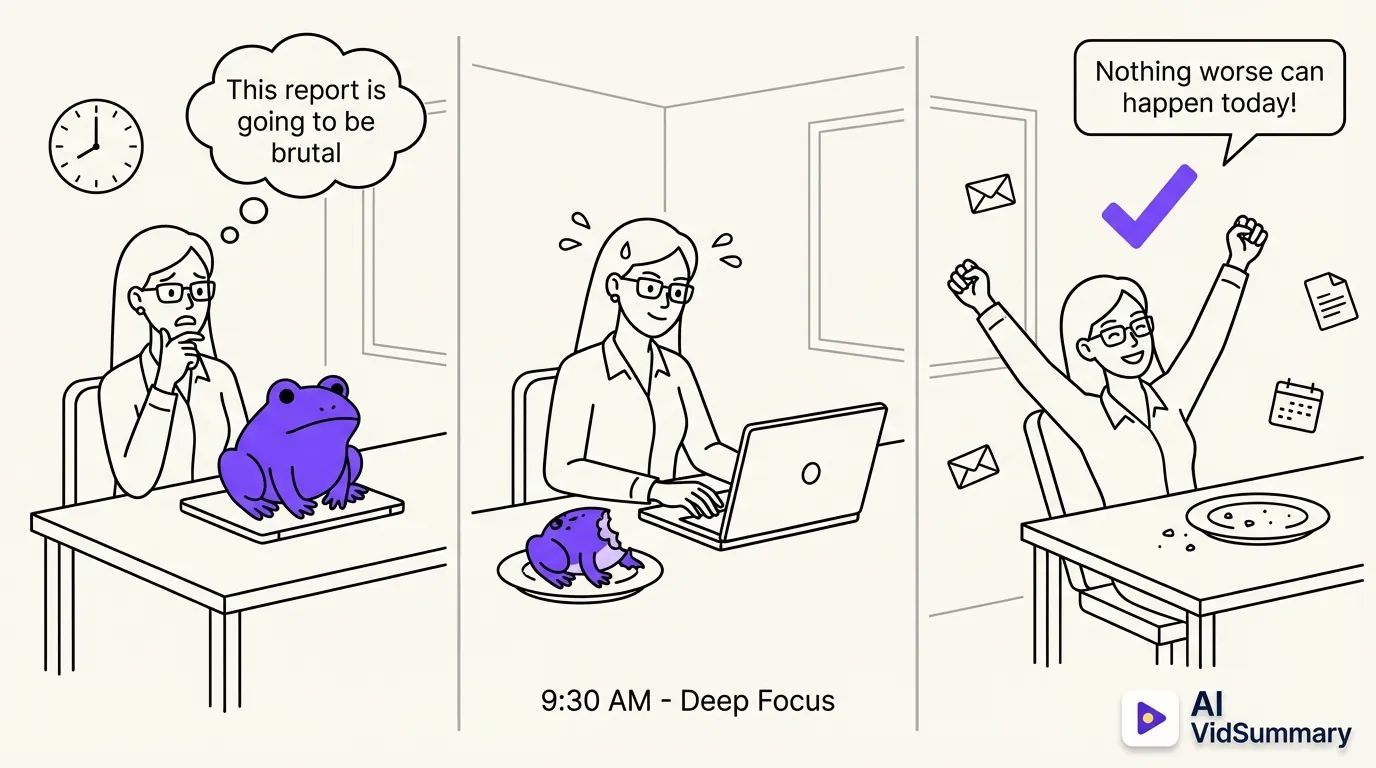
Brian Tracy's Eat That Frog method is simple. Identify your most challenging or important task. Complete it first thing when your energy is highest.
Mark Twain said if you eat a frog first thing in the morning, nothing worse will happen all day. If you must eat two frogs, eat the biggest one first. This prevents procrastination on difficult tasks. It builds momentum that carries through the rest of your day.
Professionals who consume educational video content can use AI VidSummary as a time-saving resource for extracting key insights from training videos and webinars without watching full recordings.
The Pomodoro Technique Prevents Burnout
The Pomodoro Technique follows a simple pattern:
- Work in focused 25-minute sprints
- Take a 5-minute break
- Repeat
- After four cycles, take a longer break of 15-30 minutes
This maintains concentration without mental fatigue. Research on productivity cycles shows our brains need regular breaks to maintain peak performance.
SMART Goals Give You Clarity on What Matters
SMART goals are Specific, Measurable, Achievable, Relevant, and Time-bound. Replace "Improve work efficiency" with "Complete project reports by Friday afternoon." The specificity eliminates ambiguity about what success looks like. Time management experts emphasize this framework for a reason. Vague goals create vague results.
AI Automation Saves High Performers 97 Minutes Every Week
The Data on AI Tools and Professional Performance
Slack AI saves users an average of 97 minutes weekly.
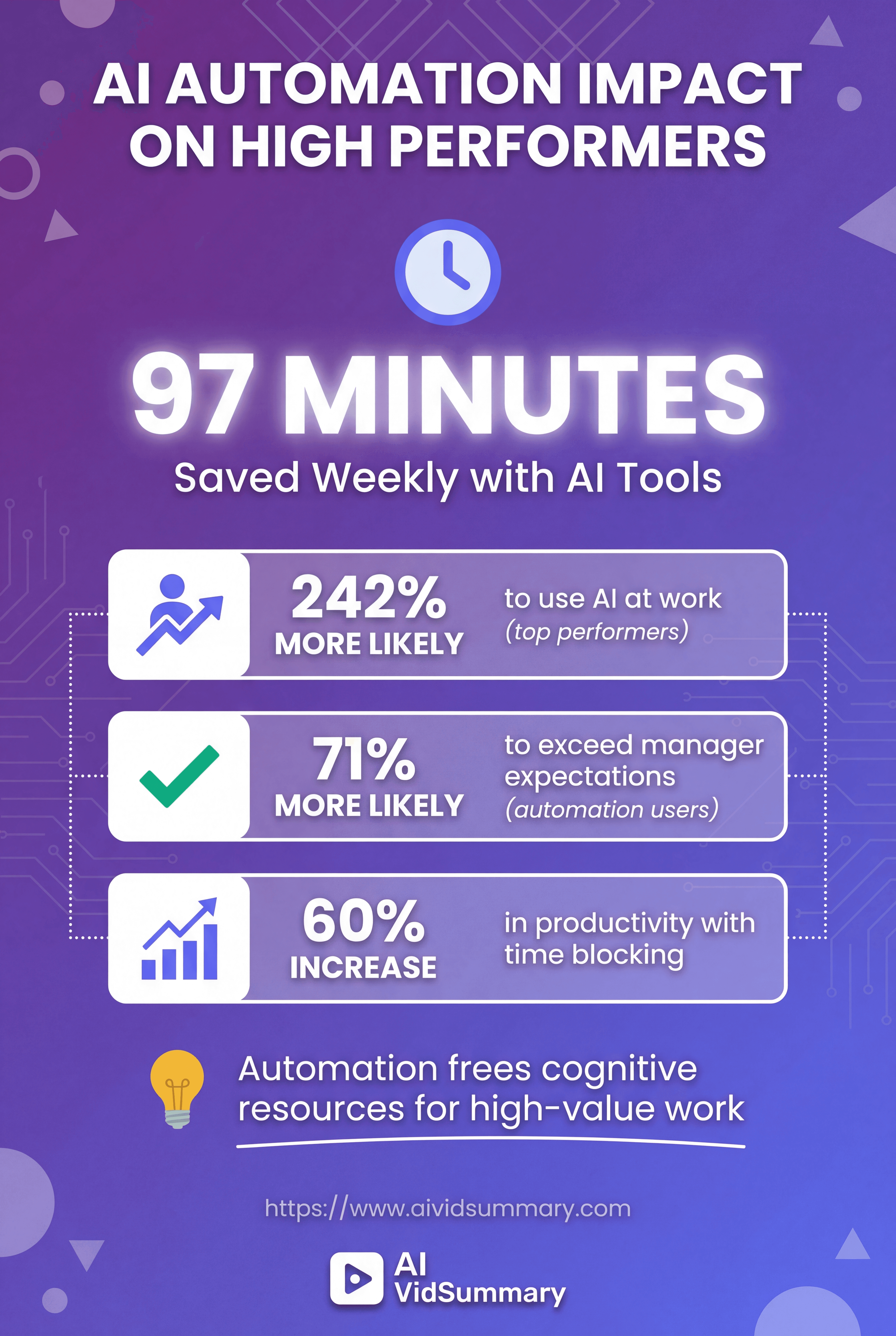
It summarizes conversations and answers questions instantly. Top-performing employees with better well-being are 242% more likely to use AI at work. Those who automate workflows are 71% more likely to exceed manager expectations. The correlation is clear. Automation isn't about being lazy, it's about being strategic with your cognitive resources.
What to Delegate and What to Automate
Katelyn Reilly asked herself what tasks she could outsource or drop. "I'm a perfectionist, but I've learned I can't keep a super-high bar in every single area." Identify low-value tasks consuming your time. Delegate specialized work to people with appropriate skills and experience. Effective delegation requires clear expectations while allowing autonomy. Automate repetitive tasks that follow predictable patterns. Focus your energy exclusively on high-value work only you can do. Professionals on Reddit consistently report this as the biggest productivity breakthrough they've made.
Scheduled Breaks Cut Stress by 43 Percent
Why Breaks Actually Increase Your Productivity
Workers who scheduled breaks reported 62% better work-life balance. They experienced 43% less stress than those who didn't take breaks.
That data comes from Slack's Workforce Index research. Corinne Stroum emphasizes this point: "Decompression is critical." We've become a back-to-back work culture, especially with virtual meetings. We don't build in breaks and time for reflection. Your brain isn't designed for continuous output without recovery periods. Time management fundamentals include protecting time for mental recharge, not just task completion.
How to Actually Take Breaks in Back-to-Back Culture
Block break time on your calendar like meetings. Treat it as non-negotiable. Use break time intentionally for activities that recharge you. Katelyn Reilly describes her approach: "I use that time to do whatever I want that feeds me." She listens to audiobooks, crochets, or zones out. No kid's Minecraft videos blaring in the background. Research on workplace organization shows clutter and constant stimulation reduce well-being. Pure decompression time (even 10 minutes) makes a measurable difference in afternoon productivity.
Conclusion
The Eisenhower Matrix prevents you from wasting effort on the wrong priorities. Time blocking delivers 60% better productivity through focused work periods. Eat That Frog gets your hardest task finished when energy peaks.
These aren't theory. Proven frameworks backed by data.
Start tomorrow morning by identifying your one most important task. Block 90 minutes of uninterrupted time and complete it before checking email.
Share this

About AI Vid Summary Team
We're a passionate team dedicated to transforming how people learn from video content. At AI Vid Summary, we combine cutting-edge AI technology with user-friendly design to help students, professionals, and lifelong learners extract maximum value from YouTube videos and online courses.
Try AI Vid Summary


Loading comments...