Imagine this: endless hours of cramming, highlighting entire sections, and reviewing your notes until your vision becomes blurry, only to confront the exam and witness everything slip right out of your mind your mind.
I'm Piyush Agarwal. Over the past decade, I've evolved from a struggling freelancer earning a mere $200 a month to leading Massive Impact, an agency generating around $500,000 every year. My early college experiences were chaotic, relying on rote memorization methods that simply fell short. The game-changer? Recognizing that memory isn't a fixed gift you're born with. It's a skill, refined through the principles of neuroscience. Once I started employing brain-focused learning techniques to enhance memory during my studies, my retention skyrocketed, and I genuinely began to enjoy learning.
Here's the thing most students neglect: your brain isn't a mere storage unit.
It requires specific encoding strategies, intentional repetition, and the right cues to transfer knowledge from short-term to long-term memory.
I'm about to share the exact study memory insights I wish I'd known years ago. No unnecessary details, just practical strategies you can start using now.
Why Your Brain Can’t Recall That Recently Reviewed Material
The Memory Phases Your Instructors Overlooked
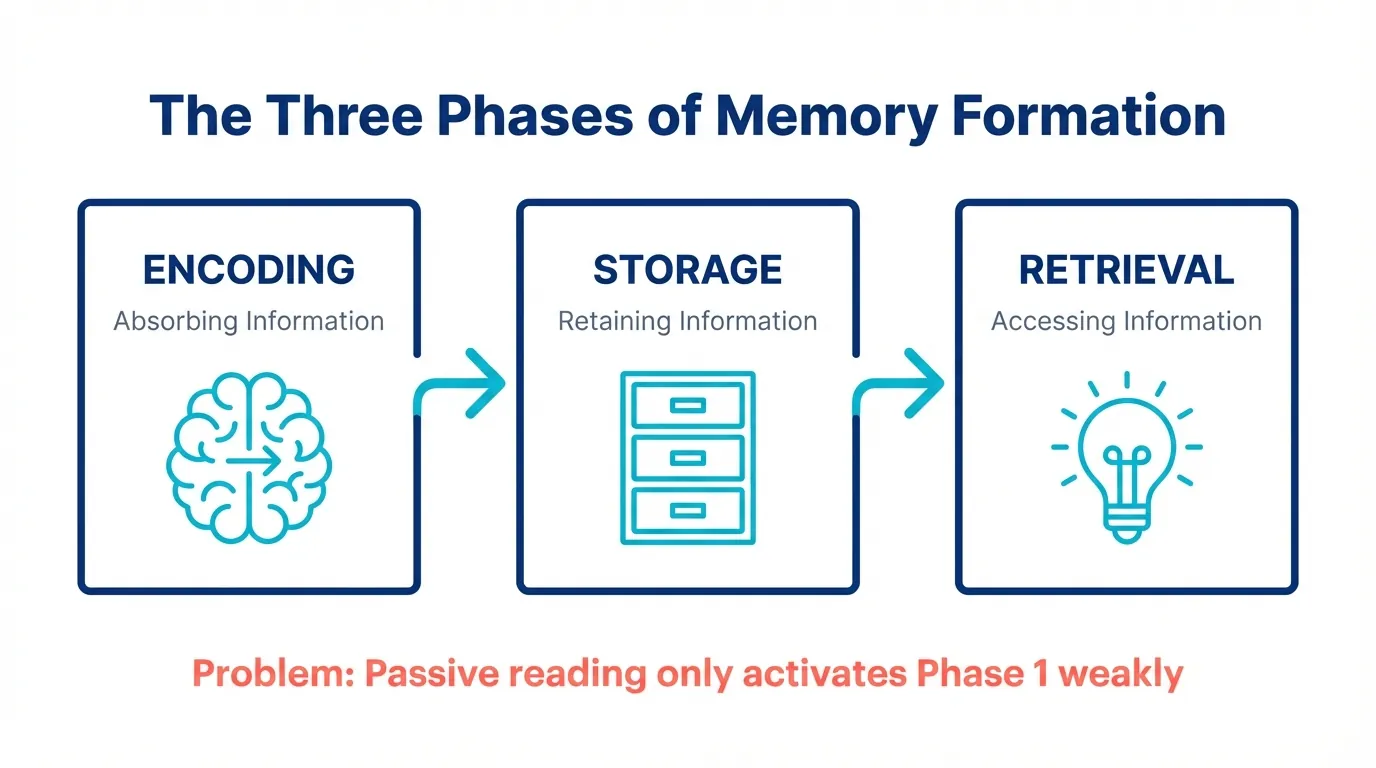
Think of your memory as something more intricate than a simple "save" button on your computer. Memory formation unfolds in three essential phases: encoding (absorbing the information), storage (retaining it), and retrieval (recalling it when needed)aining it), and retrieval (accessing it later). Students often spend countless hours just rereading notes, barely scratching the surface of that vital first phase.
The Three Phases of Memory Formation - Educational Diagram
Consider when you passively skim through textbooks, your brain processes this through the hippocampus, acting like a gatekeeper, deciding what merits being stored for the long term. But here’s the catch: passive reading creates fragile memory traces. Your brain just doesn't perceive the material as worthy of remembering. Research on memory encoding, storage, and retrieval underscores that active processing and emotional involvement are crucial for transferring information from temporary storage to permanent memory. Without this active participation, your hippocampus treats your study time like background noise. Memory consolidation primarily occurs during sleep, so staying up all night disrupts the entire process.
Imagine trying to construct a building while refusing to let the foundation settle.
The Outcome of Last-Minute Cramming
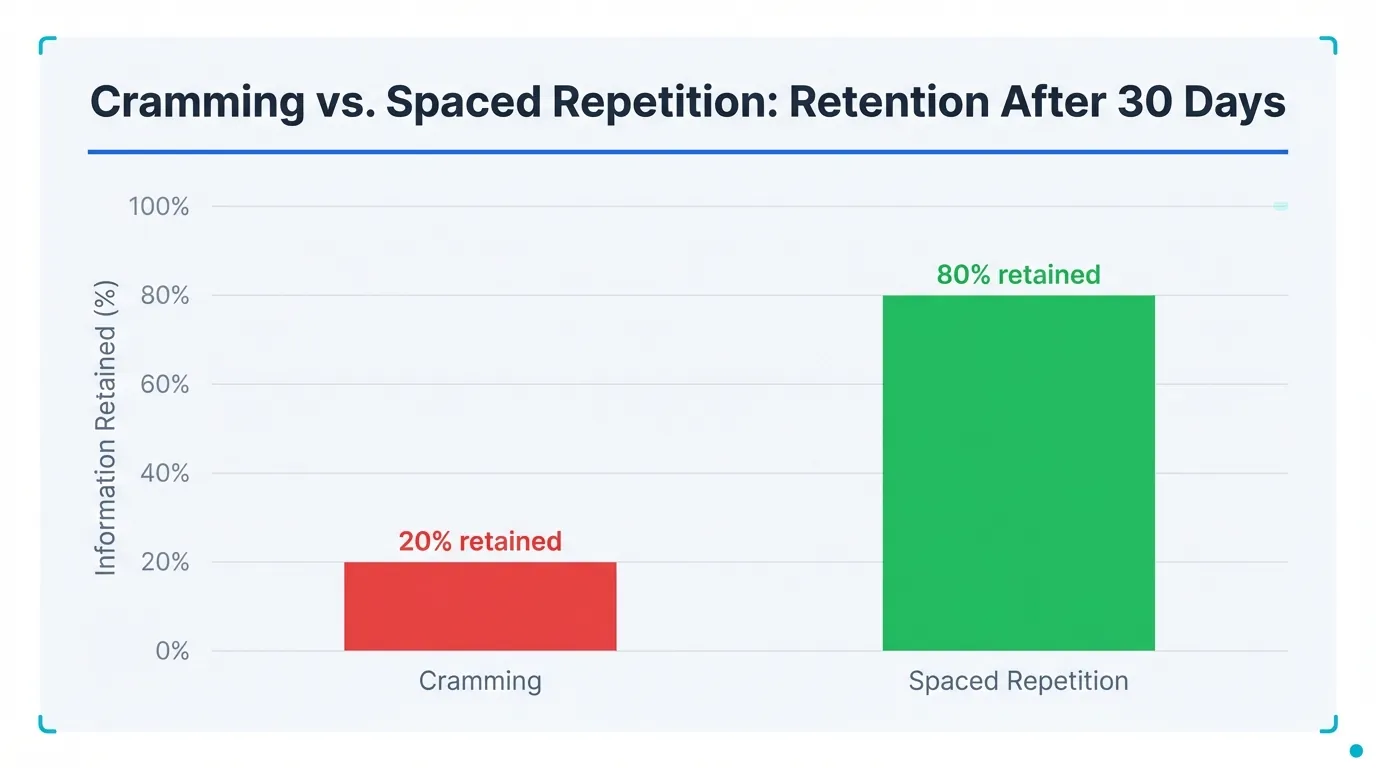
Studies indicate that cramming leads to retaining a mere20% of information after a day, whereas utilizing spaced repetition across days enhances retention to 80% (copywriting on Reddit: Copywriting: 8...). Overloading your brain causes interference, new data literally competes with what you just absorbed, effectively erasing those carefully reviewed terms like mitosis and meiosis right before your exam, despite reviewing them multiple times. The illusion of learning arises because the material seems graspable at that moment, but that's just short-term memory doing its thing.
Cramming vs. Spaced Repetition: 30-Day Retention Comparison
The trick isn't about studying longer but about studying more strategically, aligning with how our brains genuinely solidify memories.
Active Recall: Your Secret Weapon Against Forgetting
Ever found yourself highlighting the same line multiple times, only to forget it moments later? Many students are trapped in this loop, spending hours rereading notes, thinking they're learning, when in reality, their brains are merely coasting.
A Study Technique That Increases Memory by 150%
Active recall completely alters the game (r). Rather than just skimming over your notes, you make your brain extract information without any cues. When your brain retrieves details this way, it strengthens those neural connections in ways that mere reading can’t match. Harvard Health Publishing reports that students adopting active recall experienced a 150% increase in retention compared to those glued to rereading. This isn’t just a minor upgrade - it’s the difference between scraping by and excelling in exams. A lot of students stick to rereading because it feels easy and familiar, but ease doesn’t translate to effective learning.
The principle here? Simple. Each time you pull information from memory, you reinforce that mental pathway, making it more accessible. This 7 proven techniques to enhance memory retention suggests this brain-focused method is effective for all subjects and learning preferences.
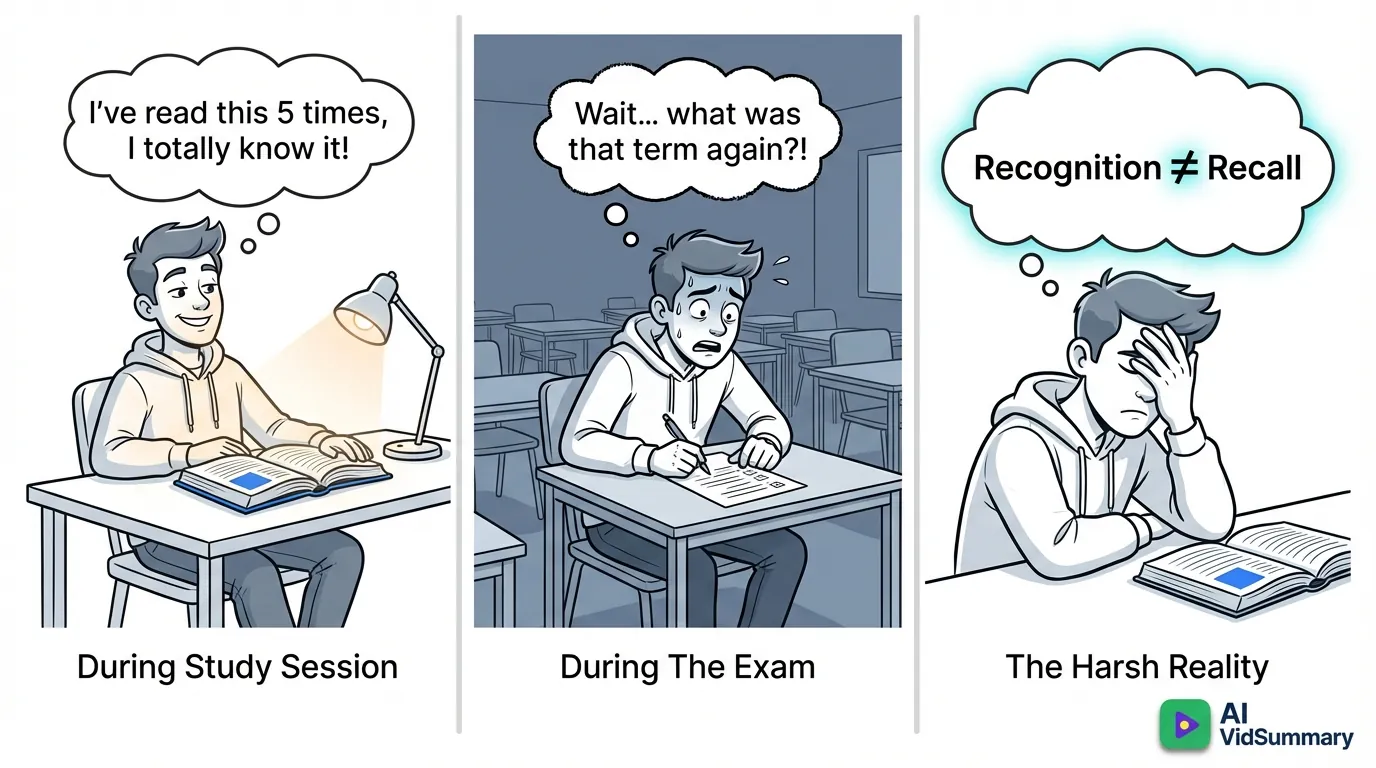
Rereading may make you feel like you know the material, but it doesn't develop true recall skills.
The Illusion of Learning: Recognition vs Recall in Studying
Embrace Active Recall Without Relying on Flashcards
For essay-heavy subjects, the blank page technique is invaluable. Shut your book, take a blank sheet, and jot down what you remember - no cheating. In STEM fields, try covering your notes and tackling problems from memory, only verifying answers after your attempt. Teaching is another powerful tool: verbalize the topic as if explaining to a complete novice. Check out writing by hand beats typing for learning, which further boosts active recall. During grad school, I revamped my memorization strategy with the blank page method, shifting from forgetting details to retaining intricate systems weeks later.
Take the plunge with one active recall session this week. Choose your toughest topic and give the blank page method a 15-minute try - you’ll notice the impact instantly.
Transforming Short-Term Memory into Long-Term Knowledge with Spaced Repetition
Why Cramming Every Day Won't Assist
Ever crammed twice within a day believing it would stick only to find it vanishes when the exam arrives? That's because your brain isn't prepared for a prompt yet.
When the material is fresh, reviewing feels easy, but you're not actually strengthening memory pathways - you're just recognizing familiar content.
What really happens in those in-between periods?
Memory consolidation is at work, transferring details from short-term to long-term storage, demanding rest and intervals. Each retrieval attempt before forgetting challenges your mind to solidify these memories, making them stronger. A 2023 study in Psychological Science supports this, showing students using spaced repetition retained 80% of the material after 30 days, compared to just 30% with cramming (The “80% power” lie | Statistical Mod...).
The real advantage emerges during the effort to recall, not from easily remembering fresh content. Proper spacing trains your brain to regard information as significant enough for permanent storage. Think about exercise - lifting weights daily won't help; muscles need recovery to grow stronger. Memory also requires "rest" to enhance learning and develop cognitive capability.
Your Go-To Review Schedule
This expanding schedule aligns with your brain's natural forgetting rhythm, capturing information just before it fades:
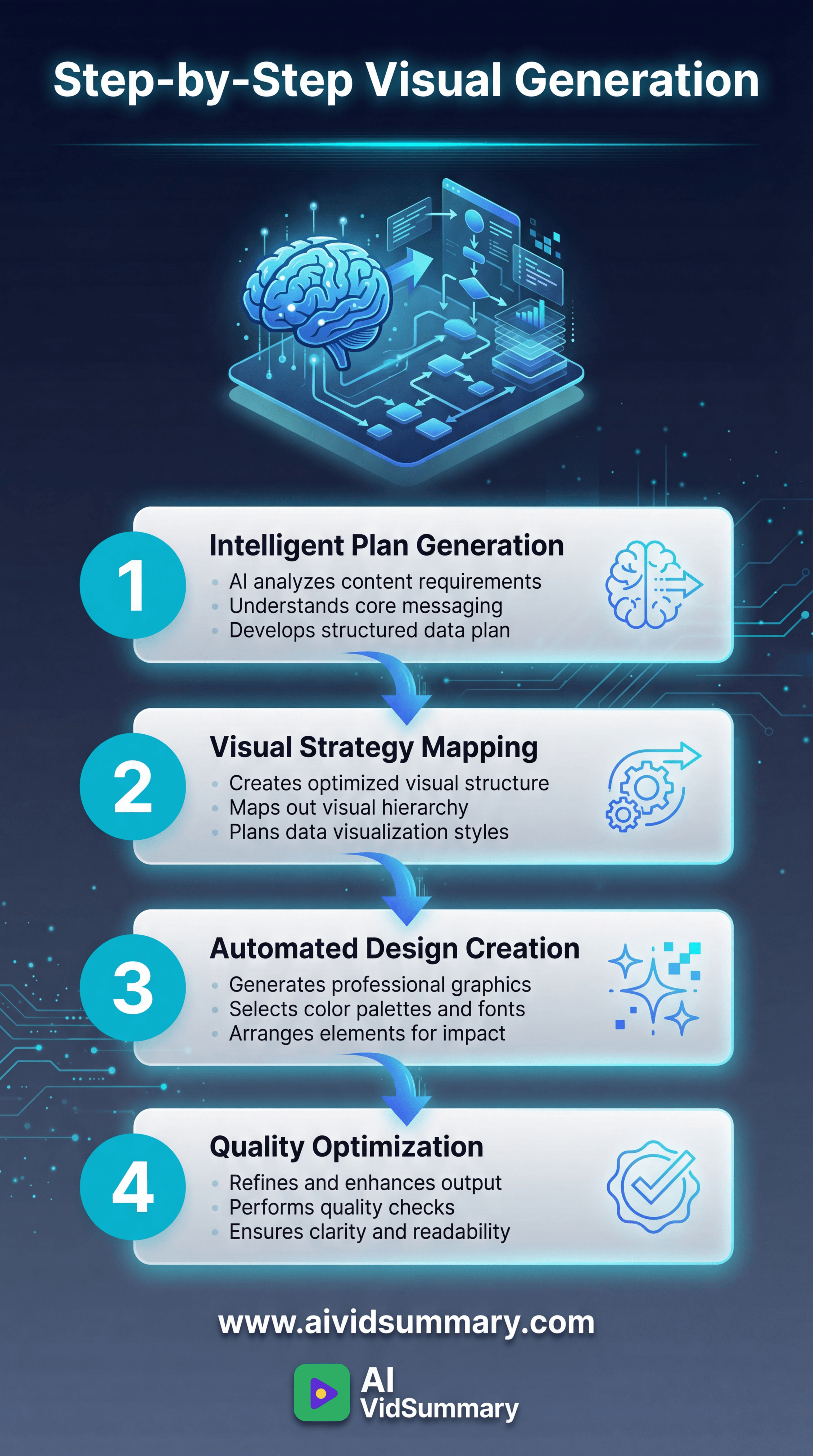
Step-by-Step Visual Generation: AI-Powered Content Creation Process
Day 1 - Learn the material
Day 3 - First review
Day 7 - Second review
Day 14 - Third review
Day 30 - Final review
For those studying video lectures, AI VidSummary can condense hours of content into digestible review portions, streamlining spaced repetition without rewatching entire videos. A basic notebook with dates and checkboxes is all you need - no fancy technology necessary.
Take Sarah, a biology major I coached. Using this method for her anatomy class in fall 2025, she swapped 8-hour cram sessions for 20-minute reviews, earning a 94% on her final. She retained this knowledge into her spring physiology course too.
Chunking Aids You Recall Complex Concepts
Ever find yourself gazing at 50 biology terms and feel like your brain's about to overload? That's your working memory maxing out.
Why Your Brain Juggles Only 7 Elements at a Time
Typically, your brain can manage around 7 pieces of information simultaneously, though stress or exhaustion can diminish this number. This is when the chunking technique and how it enhances memory comes to the rescue, allowing for efficient information encoding. Instead of memorizing 10 distinct digits, you break phone numbers into three segments: (555) 123-4567. Each segment becomes a single unit rather than separate numbers. The same method works for studying. Group related facts into significant clusters, transforming those 50 scattered facts into a tidy set of 5 chunks.
Brain-friendly learning aligns with your cognitive limits, making it a beneficial approach.
Convert 50 Facts Into 5 Memorable Groups
For history, I organize by themes, not just dates. The Industrial Revolution evolves into three memorable chunks:
Transportation Innovations - trains, steamships
Labor Changes - factories, unions
Urban Growth - cities, immigration
Three chunks instead of fifty disconnected facts.
The transformative power of visuals in learning accelerates how these chunks stick. Create simple diagrams linking related ideas in each chunk. Assign different colors for each major group. Mastering memory techniques means using both verbal and visual pathways. That's how long-term memorization strategies truly shine.
Your brain treats random facts like spam emails, constantly hitting delete.
But if you weave those facts into a narrative, tie them to what you already understand, or relate them to real-world situations, suddenly they're filed as "important, keep forever." This isn't just motivational discourse. Cognitive psychology research indicates that semantic processing, which involves linking new information to existing knowledge, forms significantly stronger neural connections than mere repetition does. By encoding information elaboratively, you create multiple access routes to the same memory. Visualize it as a web instead of a single thread - if one path fades, several others still guide you to the answer.
Retention rates differ massively. Elaborative encoding users recall 40-60% more data after a week compared to those who merely reread or highlight (Emergency vaccinations cut outbreak d...).
Why Stories Stick and Random Facts Fade
Our brains evolved to remember narratives, not isolated fragments. Linking new information to established neural networks taps into an evolutionary design that favors encoding of experiences and relationships. Neuroscience shows the hippocampus (our memory hub) lights up intensely when processing meaningful connections instead of random facts, explaining why you recall every detail of an awkward middle school incident but can't remember yesterday's formula. That cringe moment tied to emotions, social context, and existing memories - it had multiple anchors. The formula? Just hanging alone, set to be forgotten. You can fortify this by deliberately making these connections using techniques like the memory palace technique.
Three Questions to Make Learning Stick
Before wrapping up any subject, ponder these three questions:
How does this fit with what I know?
Why does it matter in real life?
What if it were different?
These queries prompt automatic elaborative encoding. In chemistry, instead of memorizing "NaCl is table salt," I ask why sodium and chlorine bond (electron transfer), what happens if I swap chlorine for another element (different compound), and where I encounter this daily (food preservation). Suddenly, it's not just a formula - it's a concept I truly grasp.
Regularly using elaborative encoding trains your brain to instinctively look for meaningful connections. Eventually, this becomes your go-to learning method.
Your 14-Day Memory Transformation Plan
You've understood the science, absorbed the strategies. Now, let’s see how to mold them into a system that truly delivers outcomes.
Here’s a step-by-step two-week approach to enhance your memory through researched tips, without overwhelming you with information. 7 tips to improve your memory
Week 1 Foundation Building
Kick off with active recall, a cornerstone of memory improvement for exams. Days 1-3: As you complete each study session, set aside materials and jot down everything you can remember (15 minutes).
Days 4-7: Introduce chunking by grouping related concepts into themes or categories before attempting recall.
This enhances learning effectiveness without necessitating flawless execution.
This enhances learning effectiveness without necessitating flawless execution.
Days 8-10: Start your first spaced review cycle. Revisit material from Day 1 on Day 3, then again on Day 8 (spacing increases each time).
Days 11-14: Incorporate elaborative encoding by probing "why" and "how" questions after each study block.
Week 2 Advanced Integration
In these weeks, the AI Chat feature in tools like AI VidSummary can assist in active recall by creating quiz questions from video learning materials, merging techniques into a seamless workflow. This transforms passive video watching into active memory engagement. Spaced reviews become more straightforward as you've encoded information in multiple ways.
You've witnessed the transition from just reading to truly engaging with your studies. The methods we discussed - like active recall, spaced repetition, memory palaces, and chunking - are more than just concepts. They're tried-and-true tactics that alter the way your brain processes and retrieves information.
Choose one approach for your next study session. Seriously, don't attempt to change it all at once (just a suggestion). Go for active recall if exams are approaching, or pick spaced repetition if you're aiming to retain information for cumulative finals. The key lies in starting, not perfecting. I've seen students get anxious about doing things "the correct way" and end up not trying at all - avoid falling into that trap. Your brain quickly adapts to new learning techniques, but it needs that first push.
Regular practice forges the neural pathways that make recall automatic.
Grab your notes right now and jot down three questions about your recent study material. Answer them without peeking. Just like that, you're beginning to train your memory for improved recall. Science supports it: active involvement trumps passive review every time, and your next study session is the perfect opportunity to see it for yourself.
Share this
About AI Vid Summary Team
We're a passionate team dedicated to transforming how people learn from video content. At AI Vid Summary, we combine cutting-edge AI technology with user-friendly design to help students, professionals, and lifelong learners extract maximum value from YouTube videos and online courses.
Our mission is to make education more accessible and efficient by providing instant, AI-powered summaries, smart note-taking tools, and interactive chat features that turn passive watching into active learning.