
How to Study from Video Lectures Without Wasting Hours in 2026

Table of Contents
The Familiar Trap of Re-Watching Lectures
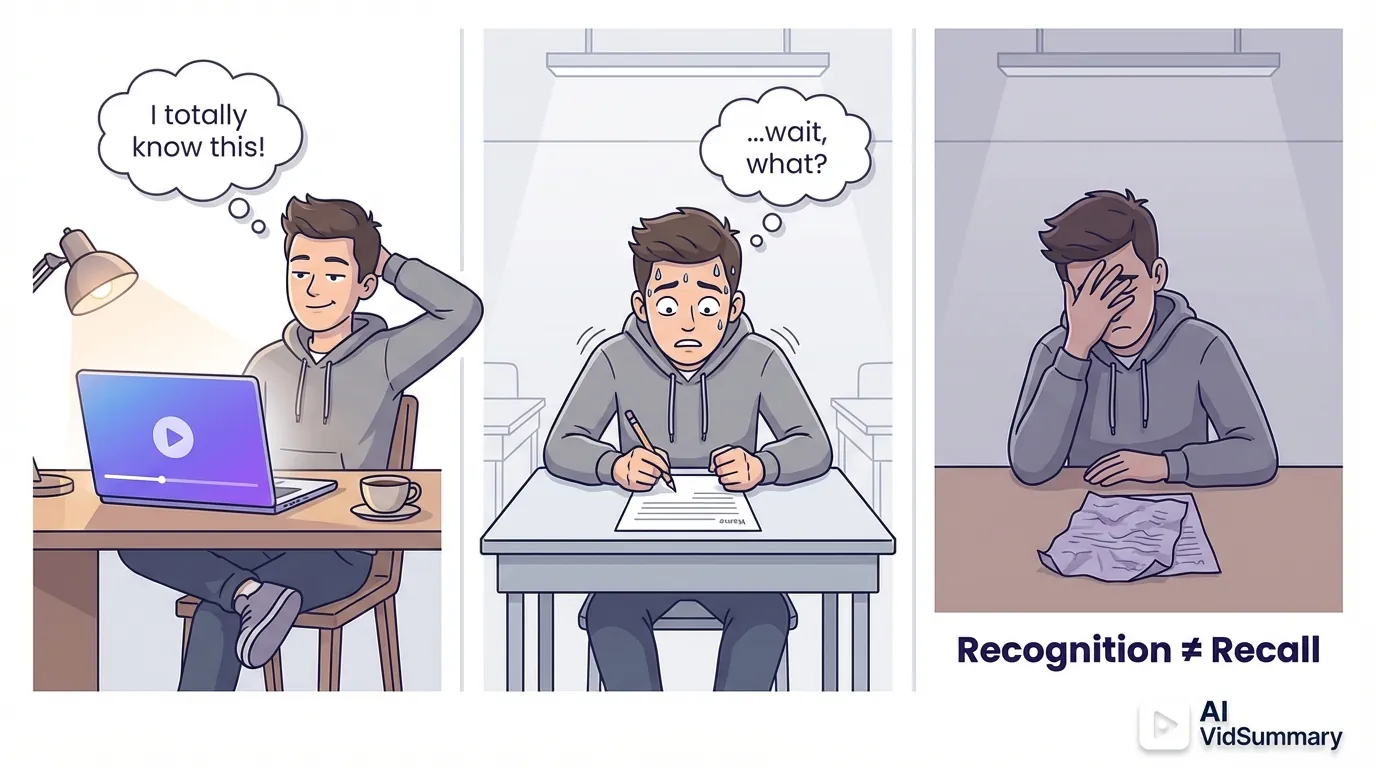
Six hours gone, re-watching last week's lectures. Felt productive, didn't it? Your brain lit up at the professor's voice, those same examples. Everything seemed recognizable. Safe.
Exam day hits. First question stares back at you. Total blankness. Those hours of watching? Gone. Vanished. The information you were convinced you'd absorbed just wasn't accessible.
Ring a bell?
Cognitive science explains exactly why this keeps happening.
Why Your Brain Treats Lectures Like Netflix Episodes
The Forgetting Curve Explains Why Re-Watching Fails
Your brain is built to forget. It's a protective feature, not a bug. Without forgetting, you'd drown in useless information.
Passive watching creates recognition, not recall.
You recognize the professor's explanation when you hear it again. You nod along thinking "yes, I know this." But recognition is the weakest form of memory. According to cognitive psychology research, familiarity feels like learning but isn't.
When exam pressure hits, recognition fails you. You need retrieval, not recognition.
That comfortable feeling? The illusion of competence.
What 72 Hours of Physics Lectures Taught One Student
One Reddit user shared their struggle with physics. They had 72 lectures to cover. Each lecture ran about four hours long.
The amount of material was insane. Traditional passive re-watching would take weeks. They weren't sure they'd ever get through it all. The sheer volume created paralysis and burnout.
As they explained: "I got distracted so many times if I watch on normal speed. I can't concentrate that way." This illustrates how the brain processes video content differently than active learning formats.
The Two Techniques That Actually Work According to Science
Active recall and spaced repetition have solid evidence behind them. Decades of cognitive psychology research support their effectiveness. Cornell learning center research confirms these methods dramatically improve retention. They work because they match how memory actually forms.
Passive re-watching doesn't create lasting memory.
Active Recall Forces Your Brain to Retrieve Information
Active recall means forcing yourself to pull information from memory. You don't look at your notes. You don't re-watch the lecture segment. You close everything and try to remember. This retrieval practice creates stronger neural pathways. Each successful retrieval makes the next one easier. The difficulty is what makes it work..
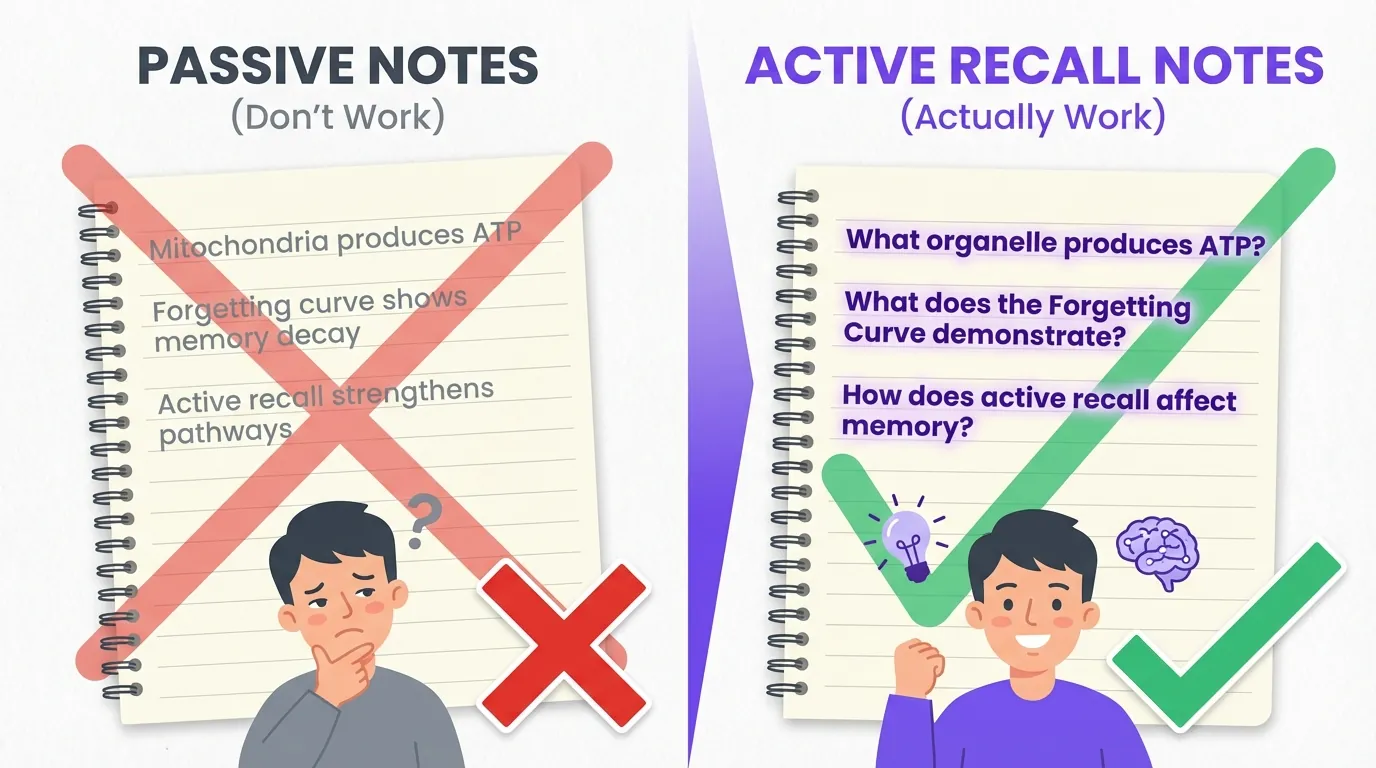
Convert every statement in your notes into questions.
Don't write "Mitochondria produces ATP." Write "What organelle produces ATP?" This transforms passive notes into active study tools. When you review, you're forced to retrieve. According to University of Minnesota study strategies, this single shift changes everything.
Spaced Repetition Signals What Matters to Your Brain
Spaced repetition reviews information at increasing intervals. First review happens 24 hours later. Second review comes three days after that. Third review occurs seven days later.
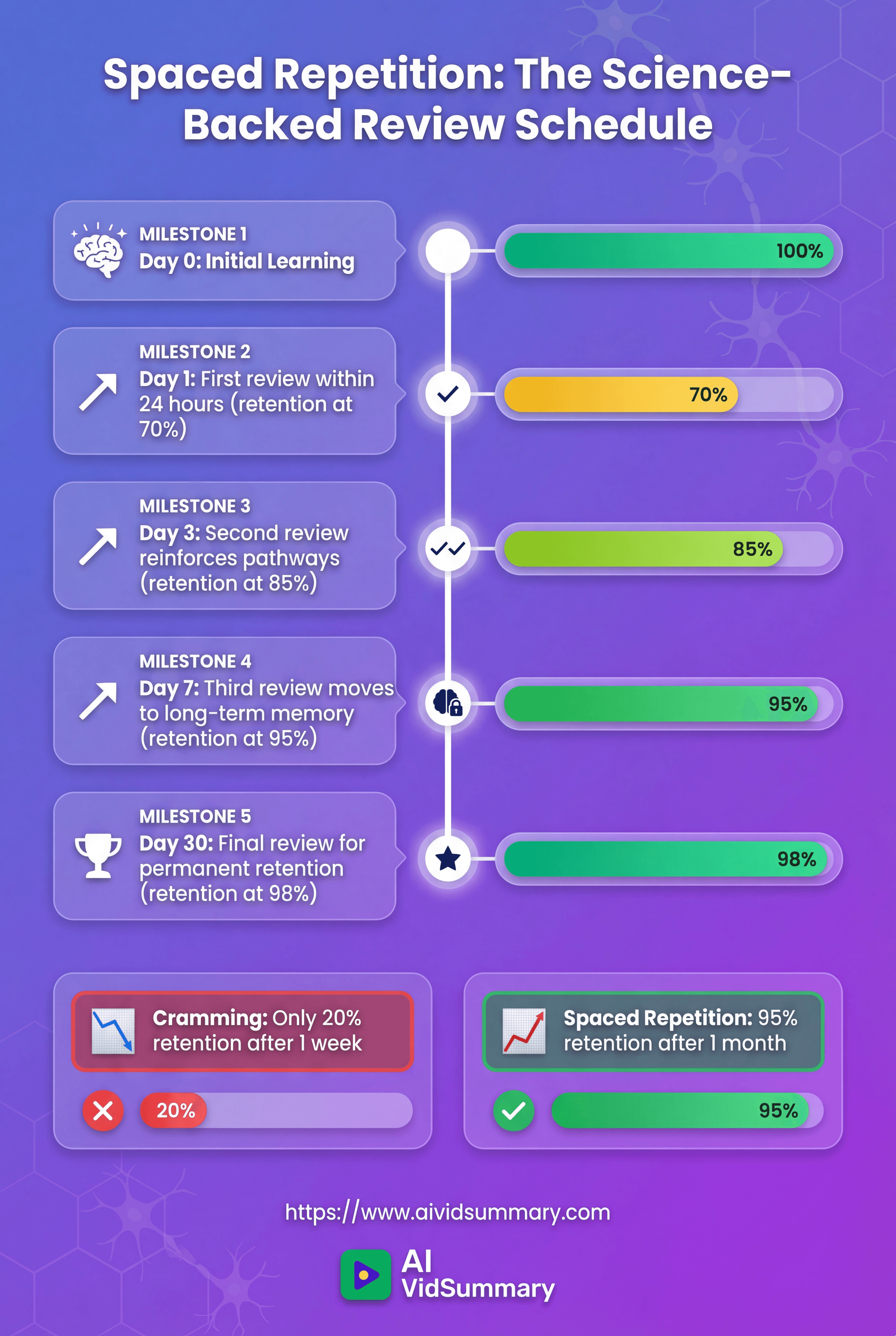
Each review sends a signal to your brain. "Hey, this information is important - don't throw it out!" The spacing is what creates long-term retention.. Cramming reviews into one session doesn't work. Your brain needs time between repetitions.
This is why starting two weeks before exams matters.
The Step-by-Step Note-Taking System That Stops the Transcription Trap
Most students try taking notes while watching lectures. They fail at both activities simultaneously.
Why You Cannot Take Notes and Understand Simultaneously
One student described the problem perfectly: "I'm too focused on copying the instructor's notes. I'm unable to really let the knowledge seep in." When you're transcribing, you're not comprehending. When you're comprehending, you can't transcribe fast enough. Your brain cannot do two complex tasks at once.
This creates a vicious cycle. You take incomplete notes without understanding. Then you must re-watch the entire lecture. The process doubles your time investment. It feels productive but delivers minimal learning.. Cognitive science confirms multitasking complex activities guarantees failure.
You need a different system entirely.
The Two-Pass System That Actually Works
Pass one is for comprehension only.. Watch at 2-2.5x speed without taking notes. Focus completely on understanding the concepts. Let the information sink in without distraction.
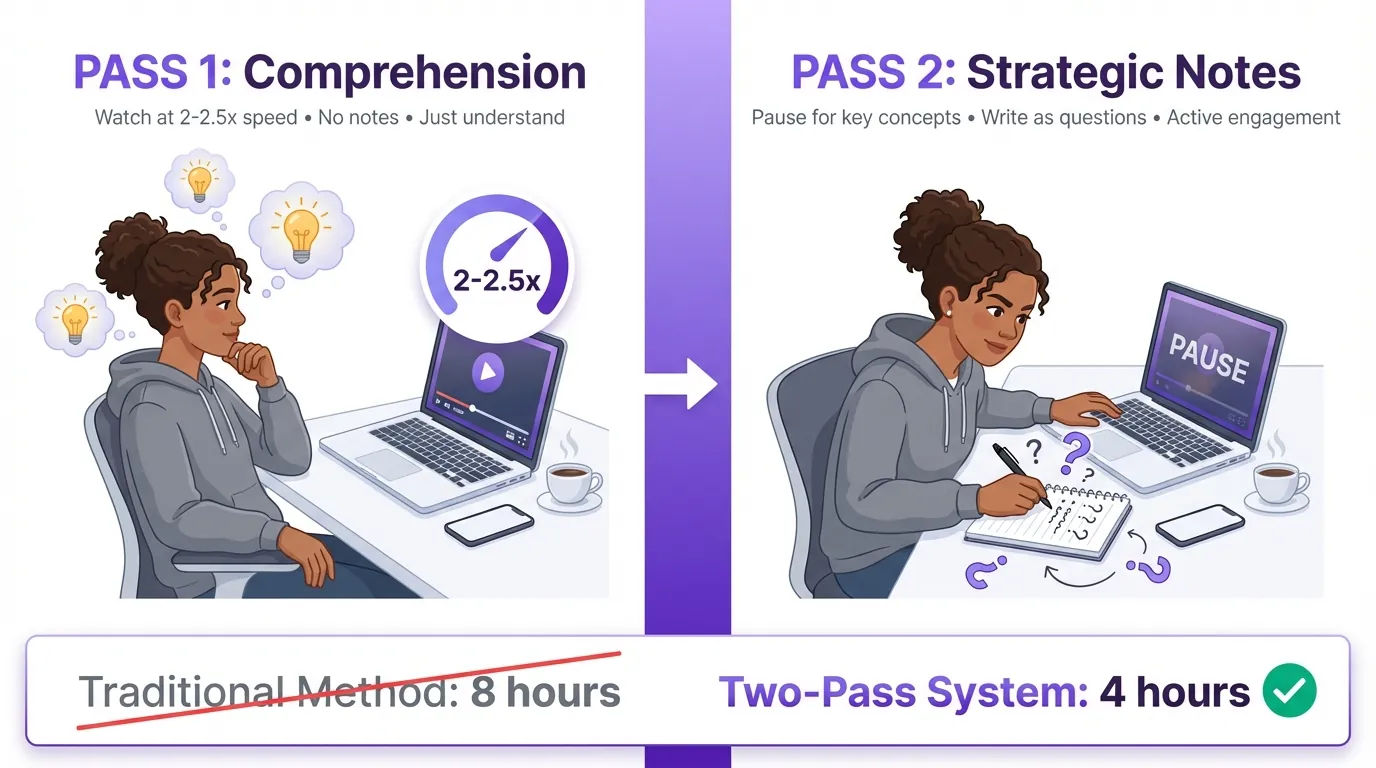
Pass two is for strategic note-taking.. Pause only for key concepts. Write your notes as self-quiz questions immediately. Don't transcribe (transform statements into retrieval practice). According to UNC Chapel Hill note-taking strategies, this approach cuts total time in half.
For example, convert "The Forgetting Curve shows memory decay" into "What does the Forgetting Curve demonstrate?"
This feels slower initially but saves massive time.
How Visual Context Saves Your Memory During Exams
You don't just remember what the professor said. You remember the specific diagram they drew. You recall the code snippet they highlighted. Visual context is critical for retention in video learning.
Text-only notes fail for video-based content.. You need screenshots of key visuals. One physics student bought a cheap graphical tablet for $20-30. It enabled efficient formula notation and diagram capture. Tools like AI VidSummary can extract accurate transcripts and key frames quickly, letting you focus on creating active recall questions rather than manual transcription.
Your exam memory will thank you.
The Playback Speed Trick That Maintains Focus
Standard playback speed triggers mind-wandering in most students. Attention slips away during drawn-out explanations. The tempo fails to align with how fast you actually process information.
Why Normal Speed Causes Mind-Wandering
That same physics student shared their approach: "On average I watch on 2-2.5x and I'm good." Accelerated playback keeps you engaged and locked in. Your brain lacks the space to drift off.. You must pay active attention. The quicker tempo actually feels more natural. According to research on video playback speed, this aligns with how we naturally process information.
Standard speed resembles watching entertainment, not learning.
This explains why lectures fade into background noise.
Finding Your Optimal Speed for Different Content
Try 2-2.5x for review sessions or familiar topics. Slow down to 1.5-2x when tackling new complex material. Make adjustments based on accent clarity and how terminology-heavy the content gets.
Your ideal speed shifts depending on what you're studying. Dense mathematical proofs demand slower playback. High-level conceptual overviews tolerate faster speeds. Trust your comprehension, not some arbitrary guideline.
Flomodoro Beats Pomodoro for Heavy Procrastinators
The traditional Pomodoro technique relies on fixed 25-minute intervals. Some students find success with it.
Why Pomodoro Fails for Immediate Focus Loss
Rigid intervals create resistance for heavy procrastinators. One student put it bluntly: "F*CK POMODORO. If you are a heavy procrastinator this technique isn't productive." Fixed 25-minute blocks feel artificial. They disrupt flow when you finally build momentum. They demand breaks when you don't need them.
The structure itself becomes another thing to resist.
The Flomodoro Formula That Adapts to Your Flow
Flomodoro relies on your natural focus duration. Study time divided by five equals break time.. Study for 45 minutes? Take a nine-minute break.. Only last 30 minutes? Take six minutes. According to time management techniques for video studying, this dynamic system rewards sustained focus naturally.
The formula adapts to your actual concentration patterns. You're not fighting arbitrary time blocks. You're working with your brain's natural rhythms. Resistance drops and actual study time increases..
Start timing your natural focus periods today.
The Phone Elimination Strategy That Actually Works
Your phone is engineered to destroy focus.
Why Willpower Alone Cannot Beat Engineered Addiction
Apps are designed by teams of psychologists.. They exploit your brain's reward systems. Variable reward schedules create addictive checking behavior. According to academic research on digital distraction, willpower is an insufficient resource against this engineering.
You need environmental design, not discipline. Remove the temptation entirely. Create physical barriers to access.
Simple blocking apps won't cut it.
The Parent Lock Method That Forces Focus
One student shared their solution: "Give your phone to your parents. Hand those keys to your mother." Physical removal works when digital blocking fails. Lock it in another room. Give the key to someone else.
This creates genuine barriers to distracted checking. You can't unlock what you can't reach. The friction is what saves your focus.
The 2-3 Week Exam Prep System Built on Spaced Repetition
Cramming the week before exams wastes spaced repetition's power. You need minimum two to three weeks.
Anything less forces ineffective last-minute memorization.
Why You Need Minimum 2-3 Weeks for Real Retention
Spaced repetition requires multiple review cycles at increasing intervals. The 24-hour review comes first. The three-day review follows. The seven-day review locks it in. This schedule needs time to unfold. Cramming compresses all reviews into 48 hours. Your brain doesn't get the spacing benefit. The compounding effect of proper spacing disappears completely..
Start exam prep when you first learn material.
The Final Week Consolidation Schedule
Days seven through five focus on mock exams. Take full practice tests under exam conditions. Diagnose your weak areas through mistakes. Days four through two target identified gaps. Review only what you got wrong. Fill specific knowledge holes, not everything.
The day before exam is light review only.. Build confidence with familiar material. Don't try learning anything new.. Your brain needs consolidation time, not cramming. Tools like AI VidSummary can help you quickly review lecture summaries for final confidence checks.
Trust the work you've already done.
The Feynman Technique Reveals What You Actually Know
Try explaining concepts in simple language to others. Pretend you're teaching someone with no background. Use only basic vocabulary and everyday examples.
This immediately reveals incomplete understanding. You'll stumble where knowledge gaps exist. Those stumbles guide your targeted review. The Feynman Technique is brutal honesty about what you actually know versus what you recognize..
Use these gaps to focus your final prep.
Transform From Passive Viewer to Active Learner
Moving from passive watching to active recall makes all the difference. You stop being a transcriptionist or someone who just consumes content.
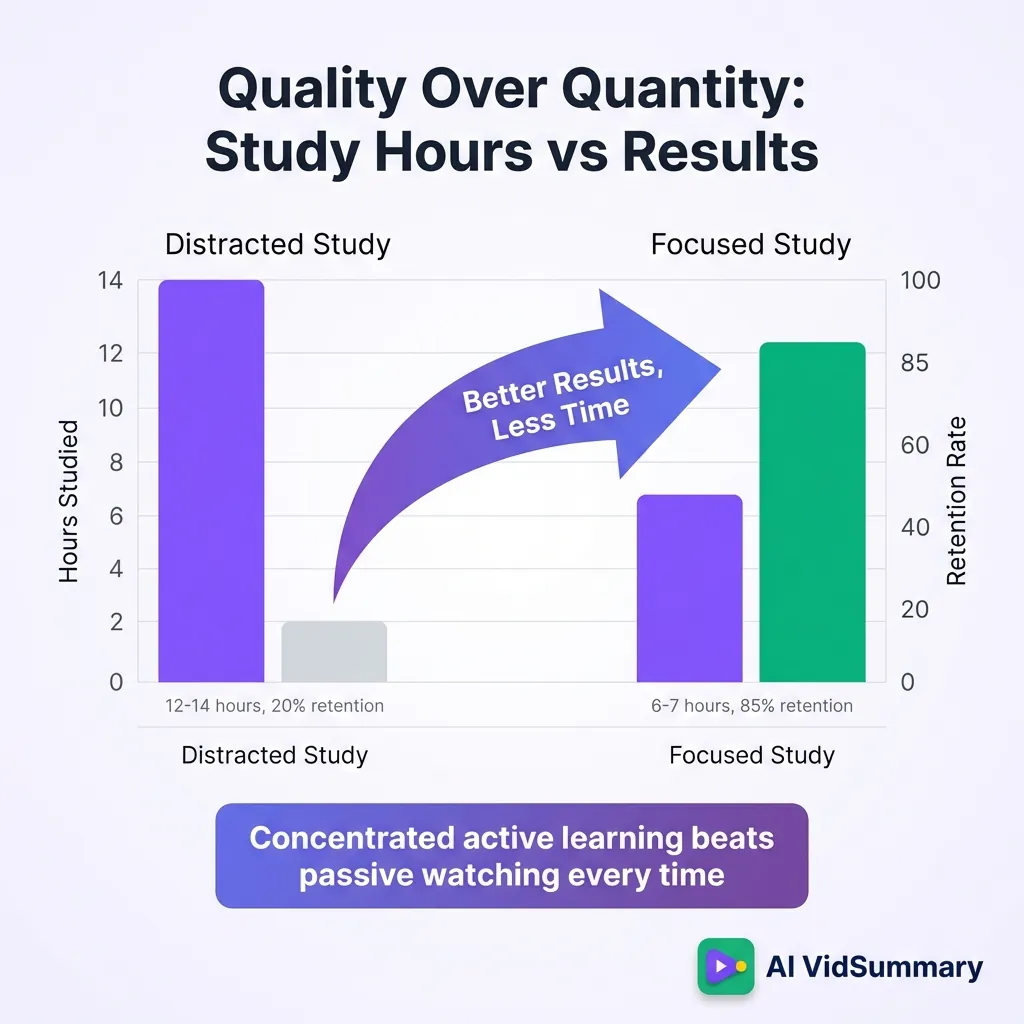
Quality wins over quantity.. Six to seven hours of concentrated study outperforms 12-14 hours when you're distracted.. One student putting in 12-14 hours daily saw worse results than focused peers. Intelligent study with real concentration produces better outcomes.
Pick one lecture today. Turn your notes into self-quiz questions. Test yourself without looking at answers. Schedule your first spaced repetition review for tomorrow.
That's actually how you learn from video lectures.
Share this

About AI Vid Summary Team
We're a passionate team dedicated to transforming how people learn from video content. At AI Vid Summary, we combine cutting-edge AI technology with user-friendly design to help students, professionals, and lifelong learners extract maximum value from YouTube videos and online courses.
Try AI Vid Summary


Loading comments...