
Zettelkasten for Students: Build a Second Brain That Actually Works in 2026
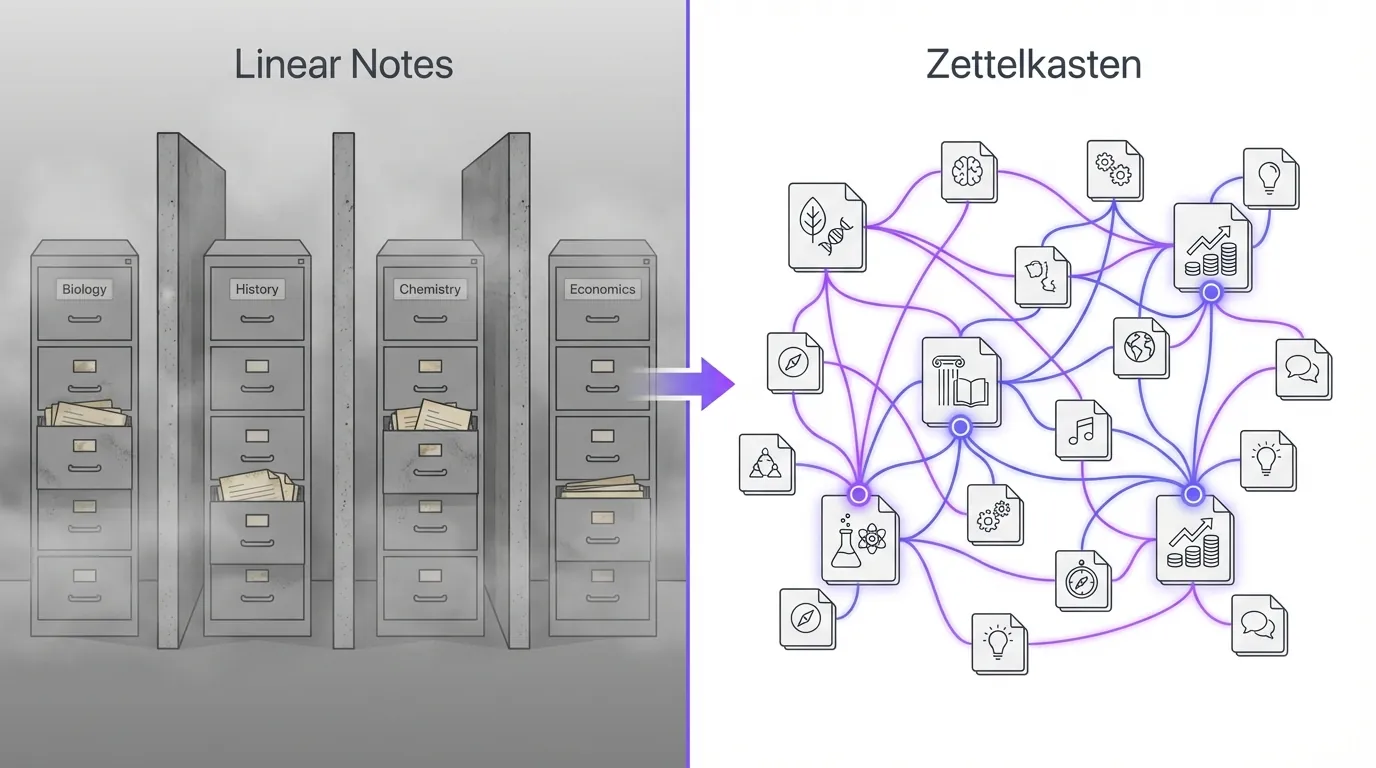
Table of Contents
Introduction
Your notes live in five separate notebooks. They don't talk to each other, and when exams roll around you're basically rebuilding everything each semester.
The Zettelkasten method changes that.
Niklas Luhmann relied on this approach to produce 70 books and 400 articles. What made it work was his collection of 90,000 linked notes that reinforced each other across decades.
Your Notes Are Broken (What Actually Fixes Them)
The Linear Note Trap
Your traditional note-taking methods sort everything by topic or alphabetical order. Biology gets one folder, history gets another. Chemistry notes and economics notes never meet.
This compartmentalized method copies how schools structure knowledge, not how your brain actually functions.
This compartmentalized method copies how schools structure knowledge, not how your brain actually functions.
Information gets stuck in isolated containers with zero chance to reveal connections. Student learning strategies research demonstrates this blocks genuine understanding.
How Zettelkasten Changes Everything
Zettelkasten builds a web of interconnected notes instead. Each note links to related concepts across every subject. Your photosynthesis note connects to energy economics, which ties into climate policy.
The system gets smarter with each addition. Cross-subject connections surface organically as your knowledge network grows. Students report uncovering insights impossible to find in linear notebooks.
The Two Core Principles That Make It Work
Atomic Notes: One Idea Per Note
Every note holds precisely one concept, written in crisp, concrete language. This turns ideas into building blocks you can reuse across any context or subject.
Write "Photosynthesis converts light energy into chemical energy through chlorophyll" rather than cramming an entire biology chapter into one note. The atomic notes principle maintains each piece compact and linkable.
Individual ideas pack serious punch because they snap together with other individual ideas. That photosynthesis note? You can connect it to energy markets, climate science, or cellular respiration. Massive document dumps titled "Biology Chapter 4" won't link to anything meaningful.
Your brain operates this exact way, filing concepts separately before connecting them.
Interconnectedness: Link Everything
Draw connections between related ideas even when they emerge from completely different classes. The interconnected note-taking approach surfaces patterns you'd otherwise miss entirely. Links birth fresh insights by exposing how concepts relate across disciplines.
Your photosynthesis note connects to renewable energy economics and carbon cycle chemistry. Effective note systems show how these connections reflect natural thought processes.
The Three Types of Notes You Need to Know
Fleeting Notes: Quick Captures
Fleeting notes are temporary thoughts you grab during lectures or reading.
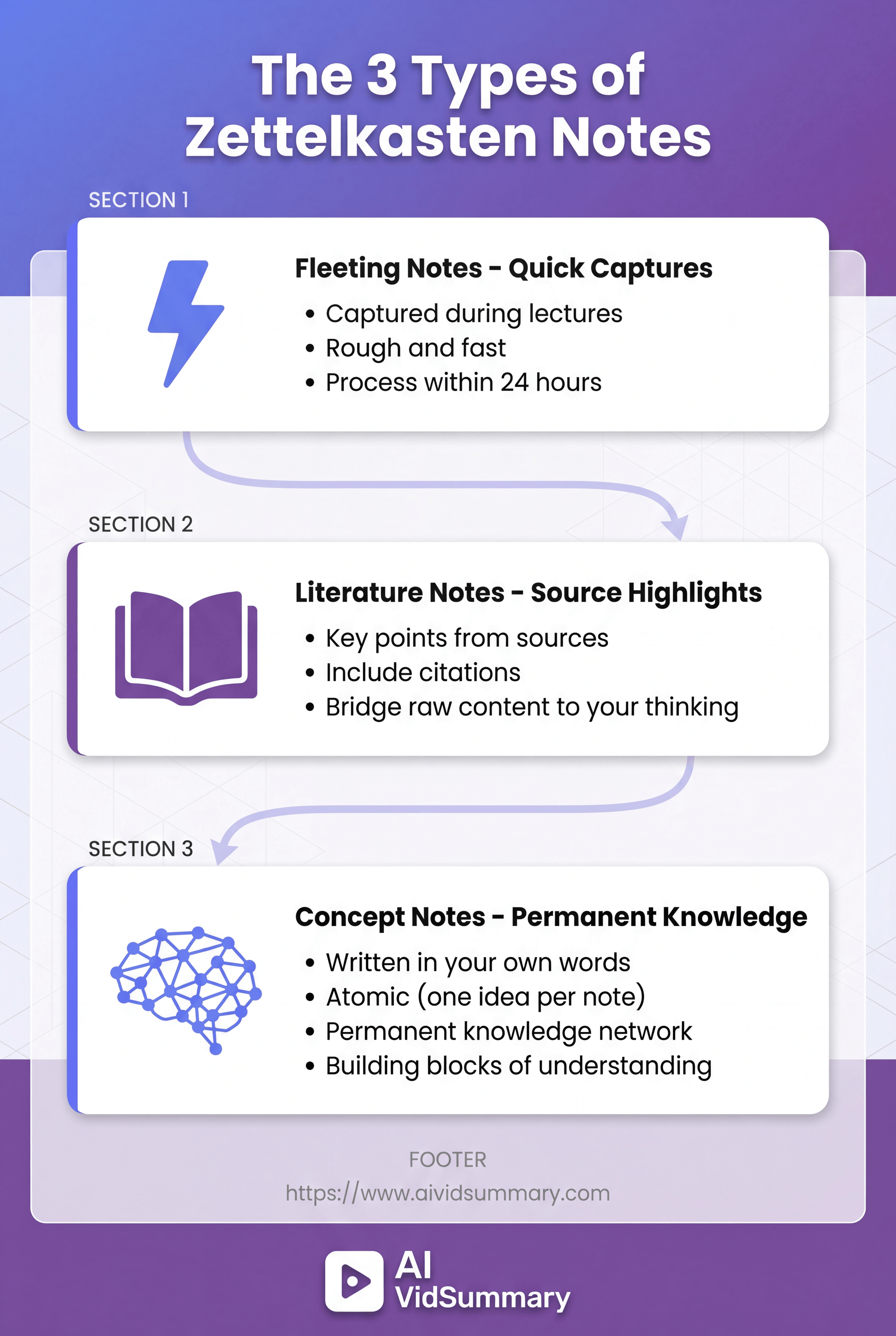
Perfect grammar? Not required. Complete sentences? Skip them. Just capture the idea fast during class or while going through your reading.
Turn these into permanent notes within 24 hours before the context slips away. The note-taking workflow recommends reviewing fleeting notes that same evening.
Literature Notes: Source Highlights
Literature notes pull key points from your sources with citations. You extract important concepts from textbooks, articles, and lecture videos for later processing.
When gathering information from video lectures or educational YouTube content, tools like AI VidSummary can help students quickly extract key points and create literature notes without rewatching entire videos. Include the source so you can cite it later in essays. Literature notes guide explains how these bridge raw content and your thinking.
Concept Notes: Your Thinking
These are refined permanent notes written completely in your own words. They include your understanding, connections, and original thoughts about the concept. Concept notes are what compound over time into your knowledge network.
The Five Mindsets That Prevent Failure
Notes Are for Understanding, Not Truth
Capture what clicks for you in this moment, even when it feels unfinished. Your grasp of any topic grows over time. No need to wait for complete mastery before writing something down.
Skip the Unimportant, Self-Explanatory, and Easy
You don't need to document every single thing you read or hear during lectures. Zero in on complex ideas that genuinely require processing and deeper thought. Ignore anything Unimportant, Self-Explanatory, or Easy to memorize without notes. This USE framework saves you from burning hours on pointless documentation.
Create Concept Notes, Not Document Dumps
Stay away from massive notes like "Entire Oceanography Chapter" or "Python Programming Overview." These bloated document notes can't link effectively to anything specific.
Split them into atomic concepts like "Ocean acidification mechanisms" or "Python list comprehension syntax." Small specific notes create way more connections and insights. Effective learning strategies prove atomic notes link 10x better.
Your Simple Three-Stage Workflow
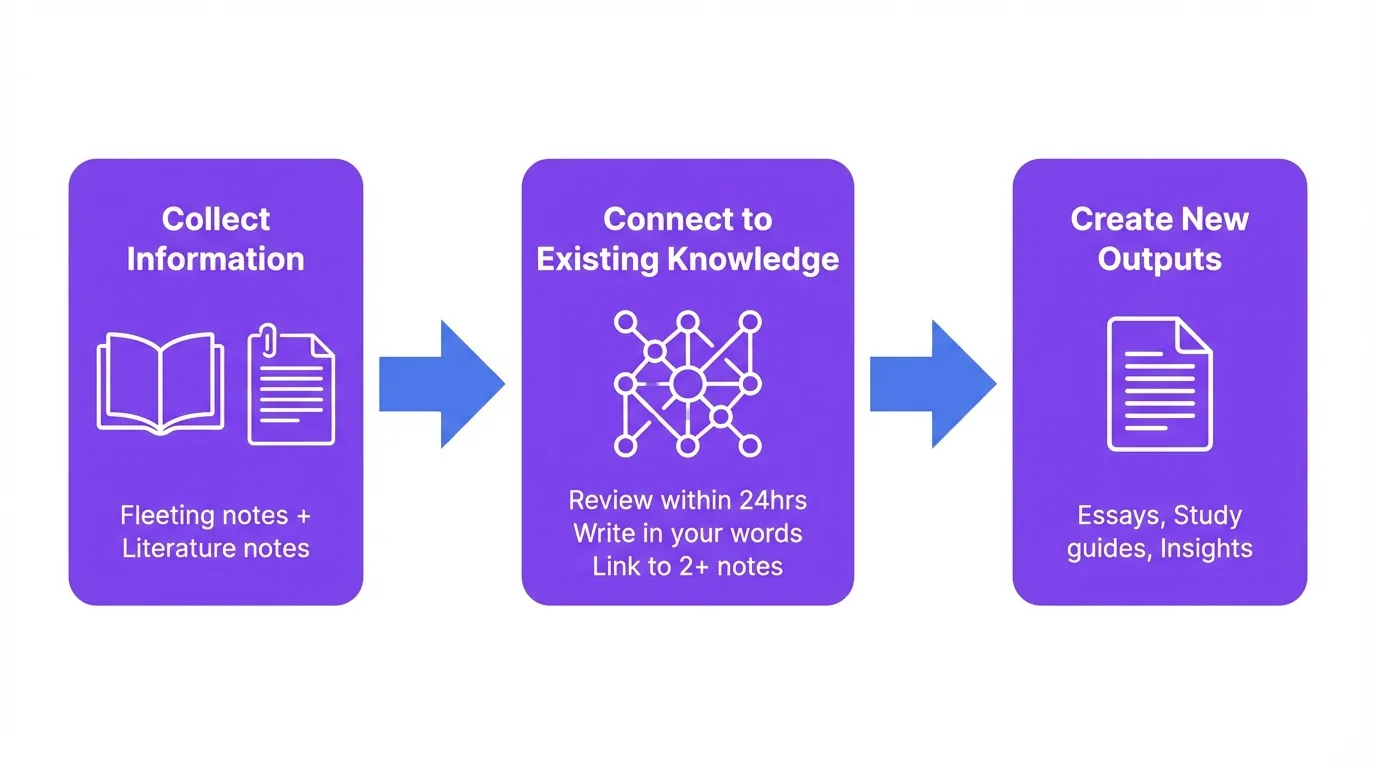
Stage 1: Collect Information
Capture fleeting notes during lectures with whatever method works for you. Build literature notes from textbook readings, articles, and educational videos. When gathering information from video lectures or educational YouTube content, tools like AI VidSummary can help students quickly extract key points and create literature notes without rewatching entire videos.
Develop a steady collection habit across your main information sources.
Stage 2: Connect to Existing Knowledge
Review your fleeting notes within 24 hours while context remains fresh. Write concept notes in your own words, not copied from sources. Link each new note to at least two existing notes in your system.
Ask yourself what this new idea relates to or contradicts. Digital note-taking tools make linking fast with search and backlinks.
Stage 3: Create New Outputs
Use your connected notes to write essays by following note chains. Study for exams by reviewing linked concepts instead of rereading textbooks. The system reveals insights and connections you'd never discover through linear review.
Getting Started in One Weekend
Choose Your Tool
Obsidian is free and popular with students for Zettelkasten implementation. Notion works well if you already use it for other tasks.
Start with a digital tool for easier linking and searching. Academic note-taking strategies recommend digital over paper for beginners.
Skip fancy features initially and just focus on writing and linking. The tool matters less than the habit of connecting ideas.
Create Your First 10 Notes
Review notes from this week's classes and readings. Create 10 atomic concept notes, each capturing one clear idea. Add at least three links between your new notes showing how concepts relate.
Build the Daily Habit
- Spend 15 minutes each evening processing the day's fleeting notes
- Create two to three concept notes daily from your literature notes
- Review existing notes weekly and add new links as connections emerge
What Happens After Six Months
Your Knowledge Compounds
Every fresh note links automatically to several others already in your system. Insights emerge across different subjects that traditional notebooks would never reveal. The value grows exponentially each semester as these connections branch out.
Note number 100? It can connect to 99 others. Number 500 has 499 possible links.

Chemistry concepts link to biology, which connects to environmental policy and economics.
Essays Write Themselves
You can trace note chains to build essay outlines in minutes, not hours. Your research already exists, captured in your own words. These note connections generate fresh arguments your professors haven't encountered before. The real thinking happened bit by bit across weeks, not during a desperate all-nighter. Effective learning outcomes data shows Zettelkasten students score 15% higher on essays.
Conclusion
Creating your first 50 notes requires genuine effort and the pace feels glacial. Six months out, though, you'll own a knowledge system that compounds every semester.
This weekend, make your first 10 atomic notes. When you're cramming for finals later, you'll be grateful you built this foundation now.
Share this
About AI Vid Summary Team
We're a passionate team dedicated to transforming how people learn from video content. At AI Vid Summary, we combine cutting-edge AI technology with user-friendly design to help students, professionals, and lifelong learners extract maximum value from YouTube videos and online courses.
Try AI Vid Summary


Loading comments...