Tackling YouTube rival research can feel like being adrift in an overwhelming ocean of endless videos, countless channels, and metrics that seem to go nowhere.
You find yourself watching their content, capturing thumbnail screenshots, and saving channel bookmarks, yet clarity remains elusive. So, what truly matters? Which strategies actually make a difference rather than just appearing flashy? Many creators waste weeks examining rivals without a clear plan, cycling endlessly through various channels, hoping for that "aha" moment.
I'm Piyush Agarwal, and in the past decade, I transformed from a scrappy freelancer making $200 a month to running Massive Impact, my agency that's generating around $500K annually. I specialize in assisting service business owners automate their operations so they can genuinely enjoy life.
The solution? A rigorous framework that cuts through the clutter, providing genuine insights. Not just *superficial* notes about upload schedules or thumbnail aesthetics, but **thorough competitive benchmarking**chmarking that uncovers content gaps, identifies audience pain points, and reveals monetization paths your competitors have overlooked. This guide details the techniques I use to track channel performance, from hands-on research to advanced AI tools that enhance your analysis.
Why Most YouTube Competitor Research Hits a Barrier
I've seen it time and again. Creators sinking entire afternoons into rival channels, jotting down scattered notes, and walking away with nothing they can utilize.
You might open 47 tabs, watch various videos, and still feel uncertain about your next steps.
The Reality of YouTube Competitor Research Overload
Here's the typical scenario.
The Trap of Endless Scrolling
You begin with the best of intentions - investigating what functions in your niche. But without a structured approach, YouTube competitor analysis transforms into mindless consumption. You might watch one video, notice the intro style, click on another channel, and get sidetracked by their editing. Before you know it, you’re watching videos rather than analyzing strategy. I’ve fallen into this trap myself, wasting entire mornings thinking I was “researching” when in reality, I was procrastinating. The issue isn’t viewing competitor content; it’s doing so without specific objectives or a systematic way to identify patterns.
Most never get beyond superficial observations.
Overlooking the Metrics that Matter
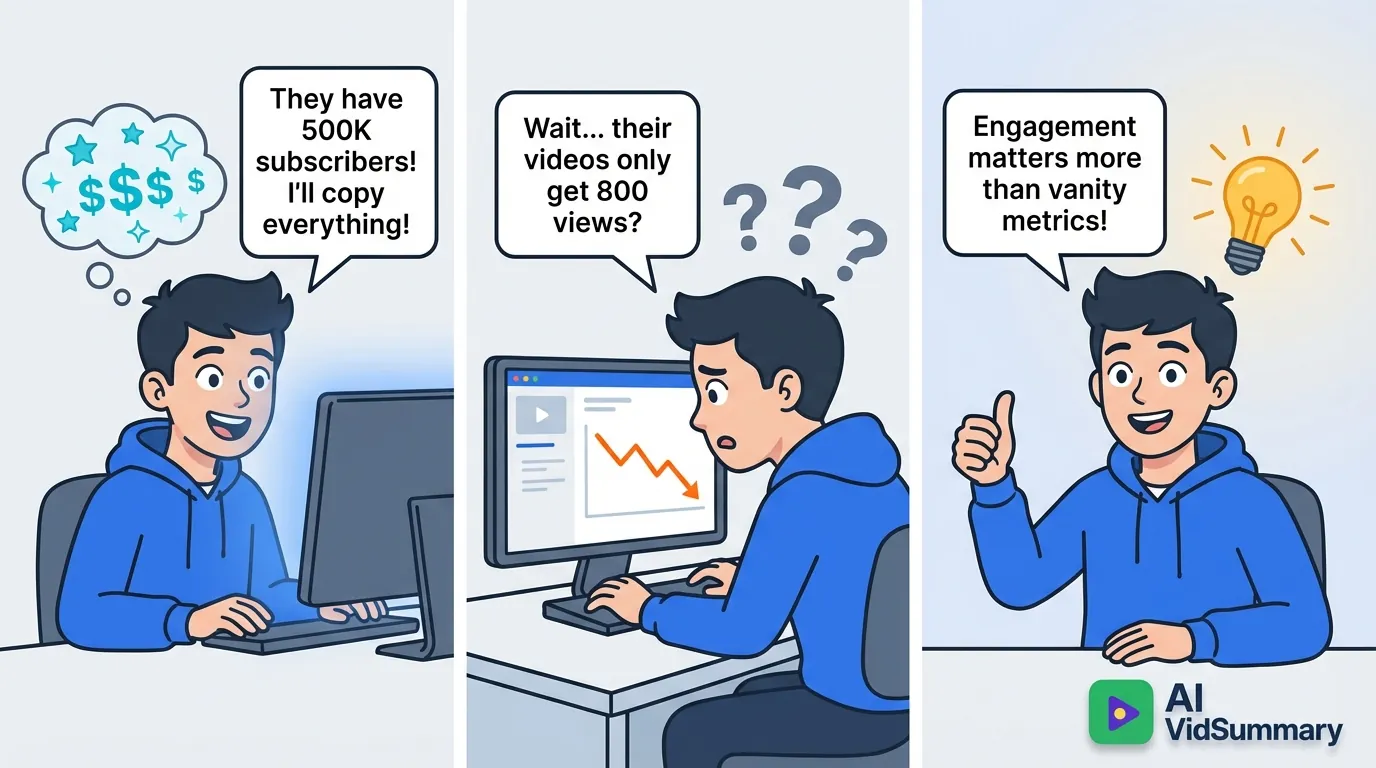
Beginners fixate on subscriber counts as if they're the holy grail of success indicators. Spotting a channel with 500K subscribers, they rush to imitate it, missing the fact that subscriber count **alone**lone reveals nothing about current performance. In my experience assisting creators launch channels, engagement metrics are far more predictive of success than vanity statistics. A channel with 10K subscribers pulling in 2K views per video within 48 hours can outperform a 100K subscriber channel averaging 800 views. Pay attention to view-to-subscriber ratios, average view duration, and comment density - these metrics show which content truly resonates.
Subscriber Count Obsession vs Real Engagement - Educational Comic
A Research Blueprint That Truly Delivers
Many creators approach YouTube rival research like they’re casually scrolling through an ex’s social media, aimlessly wandering and achieving little. I'm here to offer a structured strategy that transforms rival channels into valuable insights.
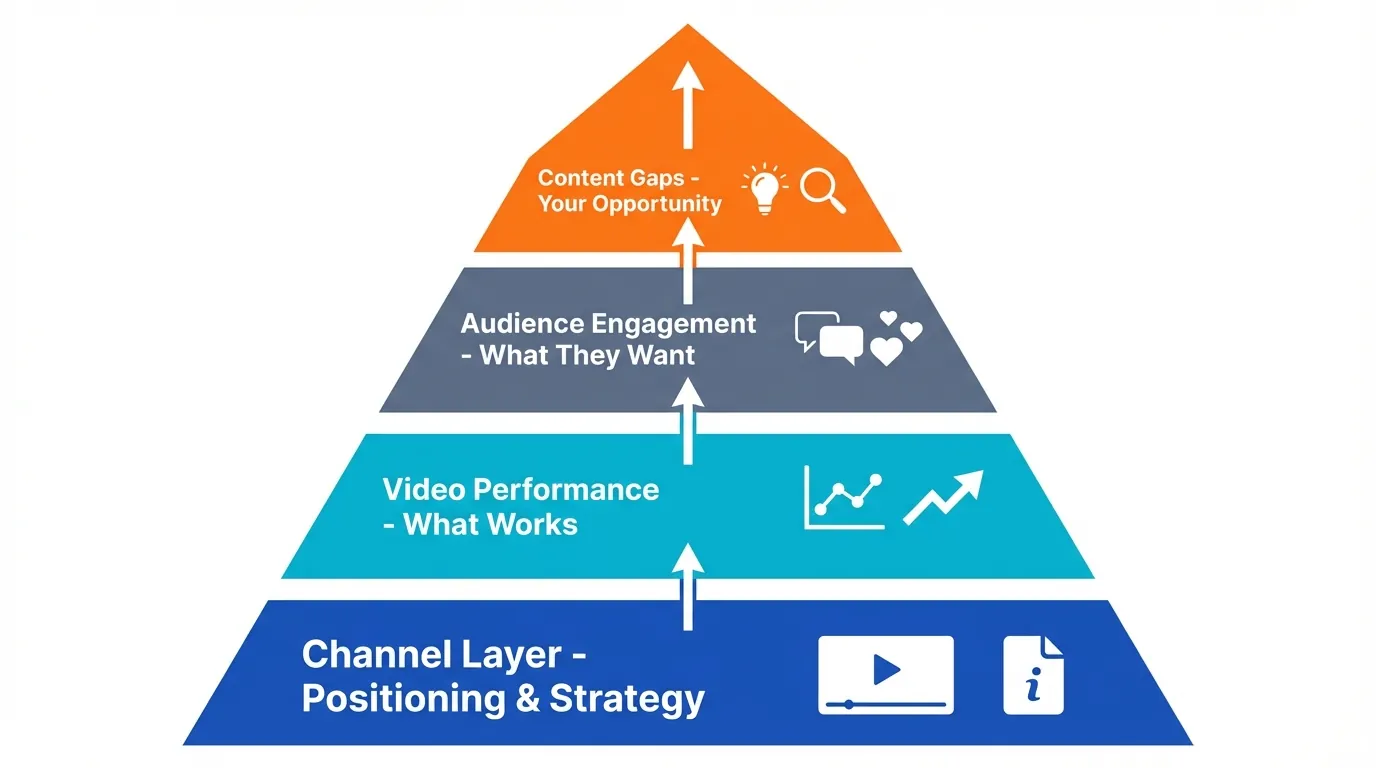
I work with a framework that divides YouTube research into four layers, each offering distinct insights about effective strategies in your niche.
YouTube Research Framework: 4-Layer Pyramid Strategy
Begin at the channel layer to grasp overall positioning, then dive into video performance patterns, audience engagement signals, and finally content gaps your competitors haven't addressed.
I kick off every competitive analysis by examining the About page with intention:
What problem is being resolved by this channel?
Who is it targeting?
What do the playlists reveal about content pillars?
The frequency of uploads gives clues about their production capabilities and audience needs. A channel posting short videos daily has a vastly different approach from one sharing in-depth weekly content. Playlists reveal how content themes are organized, guiding viewers. The channel trailer outlines their hook and value proposition.
Layer Two: Trends in Video Performance
Order their videos by popularity and identify trends in their thumbnails, titles, and subjects. Calculate the view-to-subscriber ratio to find standout content. A video with views ten times their average? That’s a topic that hit the mark. Examine the design of thumbnails, the structure of titles, and initial hooks. Don’t just list topics - analyze the angles, formats, and presentation styles that succeed.
Layer Three: Signals from Audience Engagement
Comments offer a direct line to what your competitor’s audience truly desires.
Examine top comments on successful videos:
What questions arise repeatedly?
What pain points are emphasized?
What content ideas gain traction in the community tab before evolving into full videos?
The 15-Minute Competitor Audit Method
**No need to spend endless hours** determining what functions in your domain.
I've assisted countless clients with this audit, and one thing is clear: creators often overthink when you really just need to concentrate on what drives impact. Gather actionable insights you can utilize immediately, rather than getting bogged down in excessive particulars. Historical benchmarks to see how top competitors are trending over time offer a faster way to identify patterns than doing it all manually.
Minutes 1-5: Quick Channel Overview
Open three competitor channels in different browser tabs. You'll want to scan their latest 30 days of uploads, paying attention to frequency rather than quality at this step.
Look at their mix of content types: tutorials, vlogs, reviews. Note their thumbnail consistency and title patterns without getting lost in details.
Minutes 6-12: Focus on Top Videos
Identify their top three videos from the last 90 days. Watch the opening two minutes of each, where the hooks are. I recently took note of a competitor’s video on productivity apps with **847K views**: they led with a bold claim, not a slow start, included B-roll every 8-12 seconds, and highlighted three specific tools within a minute. Your competitive intelligence for YouTube should emphasize execution styles as much as content subjects. At-Home Podcast Listening Reaches 63% in 2026: What Creators Should Do About It highlights that format is vital. Capture screenshots of their thumbnails, recording the exact wording in titles - this analysis uncovers what attracts viewers.
Minutes 13-15: Compile and Analyze
Set up a basic spreadsheet: Channel Name, Upload Frequency, Top 3 Topics, Average Views, Thumbnail Style. Include a "Gaps" column to track what they're not covering. This isn't about **imitating** - it's about identifying **opportunities**'s about spotting untapped opportunities.
Fifteen minutes, direct insights, minimal fuss.
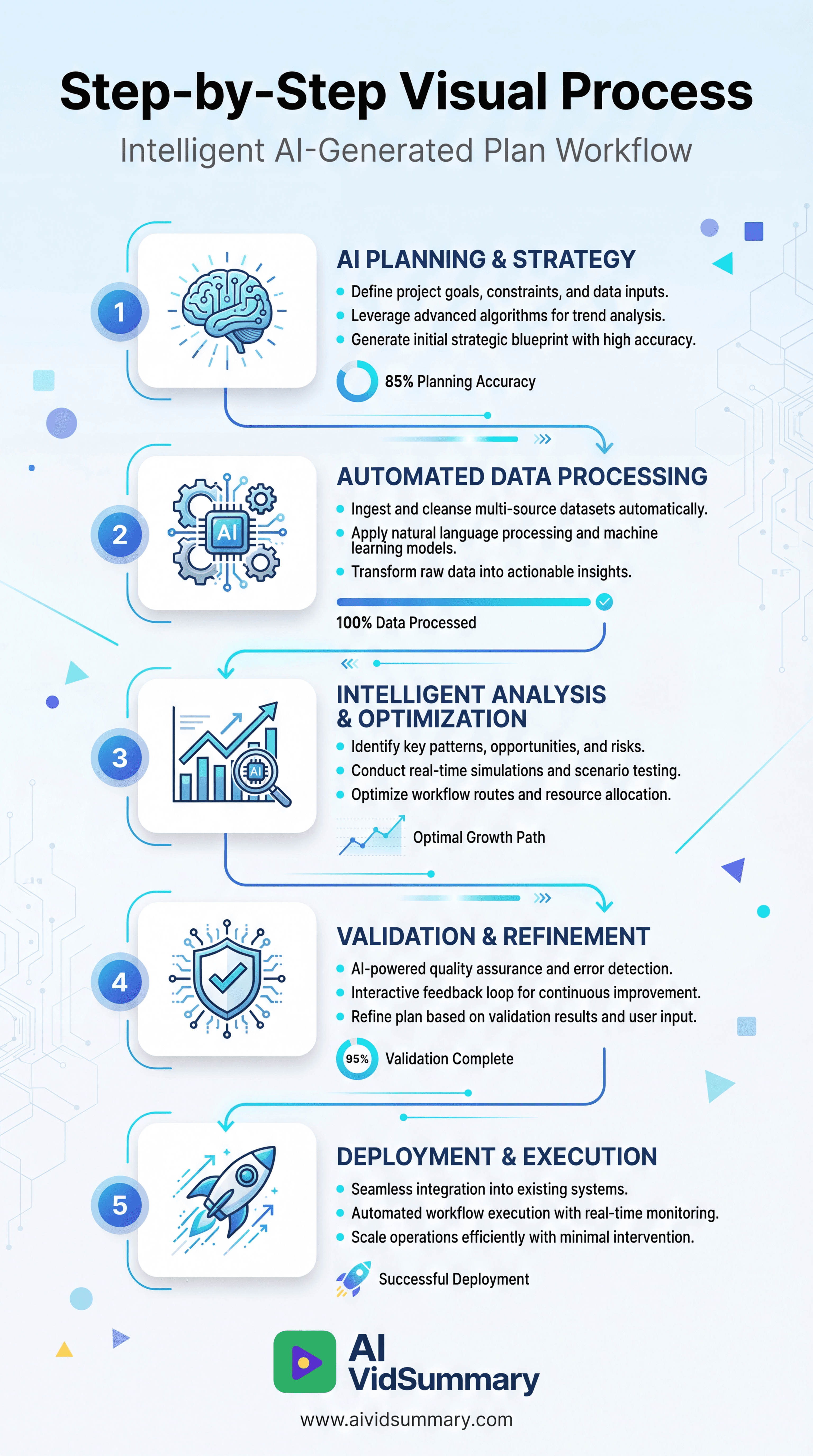
AI-Generated Step-by-Step Visual Process Infographic
Discoveries of Top Creators That You Might Overlook
Many creators observe competitor videos for inspiration but often miss the recurring patterns that are right in front of them. True insights aren't merely in what flourishing channels upload, but in what audiences are longing for and yet to receive.
Having spent years analyzing top channels across diverse niches, I can affirm a consistent trend: those who lead their fields don't just examine content, they **pinpoint the gaps**. They meticulously track which questions arise repeatedly in comments but remain unanswered. They take note of topics that garner engagement but lack depth. It's about discovering the perfect blend of what audiences desire with what competitors neglect.
Start with analyzing your top three competitors' most successful videos from the last 90 days. Tools like AI VidSummary offer creators the chance to extract vital insights from lengthy videos without watching each second, transforming a manual four-hour review into a succinct 15-minute session. Examine every comment thread for phrases like "but what about..." or "I wish you'd covered..." These indicate the gaps your audience genuinely wants filled. Validate these gaps by checking them against search volume data to confirm demand.
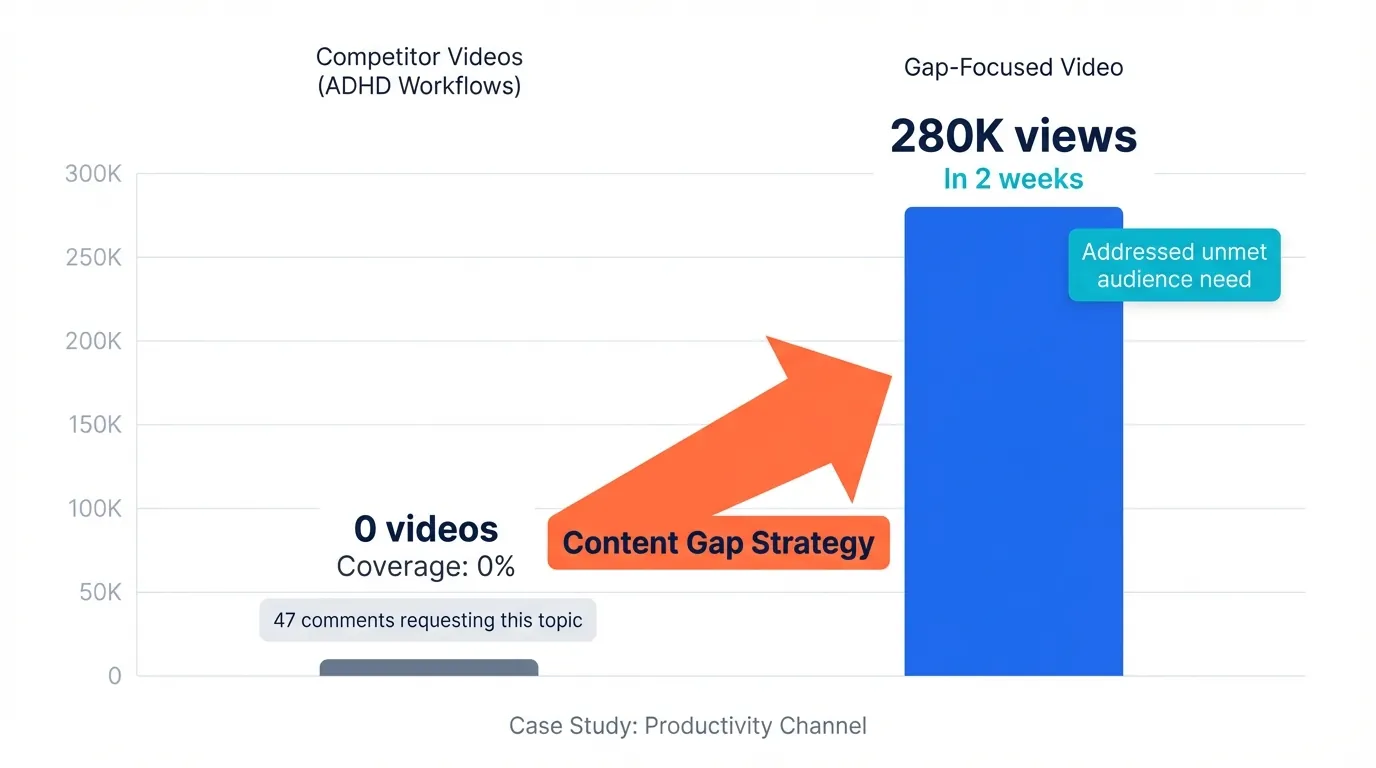
I recently partnered with a productivity channel and discovered that audiences were eager for ADHD-specific workflows - mentioned in **47 comments** across competitor videos but addressed in **none**. They tackled this gap and reached 280K views in a mere two weeks.
Content Gap Strategy Case Study: 0 to 280K Views
Reverse Engineering Successful Formats
Research Tools That Enhance Without the Strain
Manual Research Sometimes Surpasses Automation
Every week, I devote 20 minutes to personally viewing the latest videos from my top three rivals. Certainly, automated tools can monitor metrics, but they overlook the subtleties. They can't clarify why a video resonated or which daring creative decision paid off. While YouTube channel metrics provide insight into performance, scanning through top comments illuminates the concerns your audience is vocal about - something no algorithm can identify.
Context is crucial.
When delving into competitor video performance analysis, automated platforms are champions at managing large datasets: subscriber growth, how swiftly views are accumulating, and engagement rates across numerous videos. But getting to the core of why a competitor’s tutorial outshines yours involves watching their opening, noticing their pacing, and seeing how they execute their call-to-action. Tools like VidIQ and TubeBuddy lay down the quantitative groundwork, but it’s your judgment that captures the qualitative insight. For those focused on content intelligence over broad numbers, AI VidSummary offers a unique perspective by converting competitor video libraries into searchable databases, making it easier to detect content gaps and successful formats without sitting through hours of footage.
The ideal approach I’ve discovered is to depend on automation for **80% of tracking** and reserve **20% for hands-on strategy evaluation**. Competitors aren't just statistics - they're creators making deliberate decisions you need to comprehend.
Competitors Are Creators - Inspirational Business Quote by Piyush Agarwal
Three Tools That Merit Your Investment
For extensive YouTube competitor research, VidIQ is a standout for tracking channel performance across multiple rivals simultaneously. Customizable white label options for agencies are excellent for creators managing multiple channels or agencies overseeing client campaigns. TubeBuddy is a solid choice for keyword research and provides a decent level of competitive intelligence at a more economical price, though its capabilities in bulk analysis seem limited compared to VidIQ’s comprehensive offerings. And truly? YouTube Studio’s built-in analytics provide about 80% of what solo creators require at no cost: audience retention statistics, traffic sources, and search terms attracting viewers to your videos.
The question isn't about discovering the "best" tool, but rather what aligns with your research requirements. Pricing: Plans start at $199/month with a 3-keyword cap for enterprise options only makes sense if you’re analyzing dozens of competitors each week.
Begin with **free options**, and only transition to paid versions when manual work becomes overwhelming.
Conclusion
Spending countless hours observing random rivals? Totally unproductive.
But YouTube competitor analysis can be invaluable if you adhere to a structured plan: select three channels in your domain, analyze their top-performing content from the past 90 days, and identify gaps they're missing.
Begin with straightforward 15-minute manual audits before investing in any tools.
Utilize a spreadsheet, choose your top three competitors, and examine their latest 10 videos this week. Review views, thumbnails, titles, and those essential first 30 seconds. You'll recognize patterns faster than any AI tool - and you'll understand why particular content resonates within your niche.
It's not about imitating competitors. It's about mastering the game to play it better using your unique voice and perspective.
Share this
About AI Vid Summary Team
We're a passionate team dedicated to transforming how people learn from video content. At AI Vid Summary, we combine cutting-edge AI technology with user-friendly design to help students, professionals, and lifelong learners extract maximum value from YouTube videos and online courses.
Our mission is to make education more accessible and efficient by providing instant, AI-powered summaries, smart note-taking tools, and interactive chat features that turn passive watching into active learning.